Your benefits portal wants to know how much life insurance you'd like. A relative wants to "walk you through" a policy over coffee. Or you've found a statement for a policy your mom bought decades ago. Each time, the same question comes up: how does life insurance work, and what has to happen for it to pay?
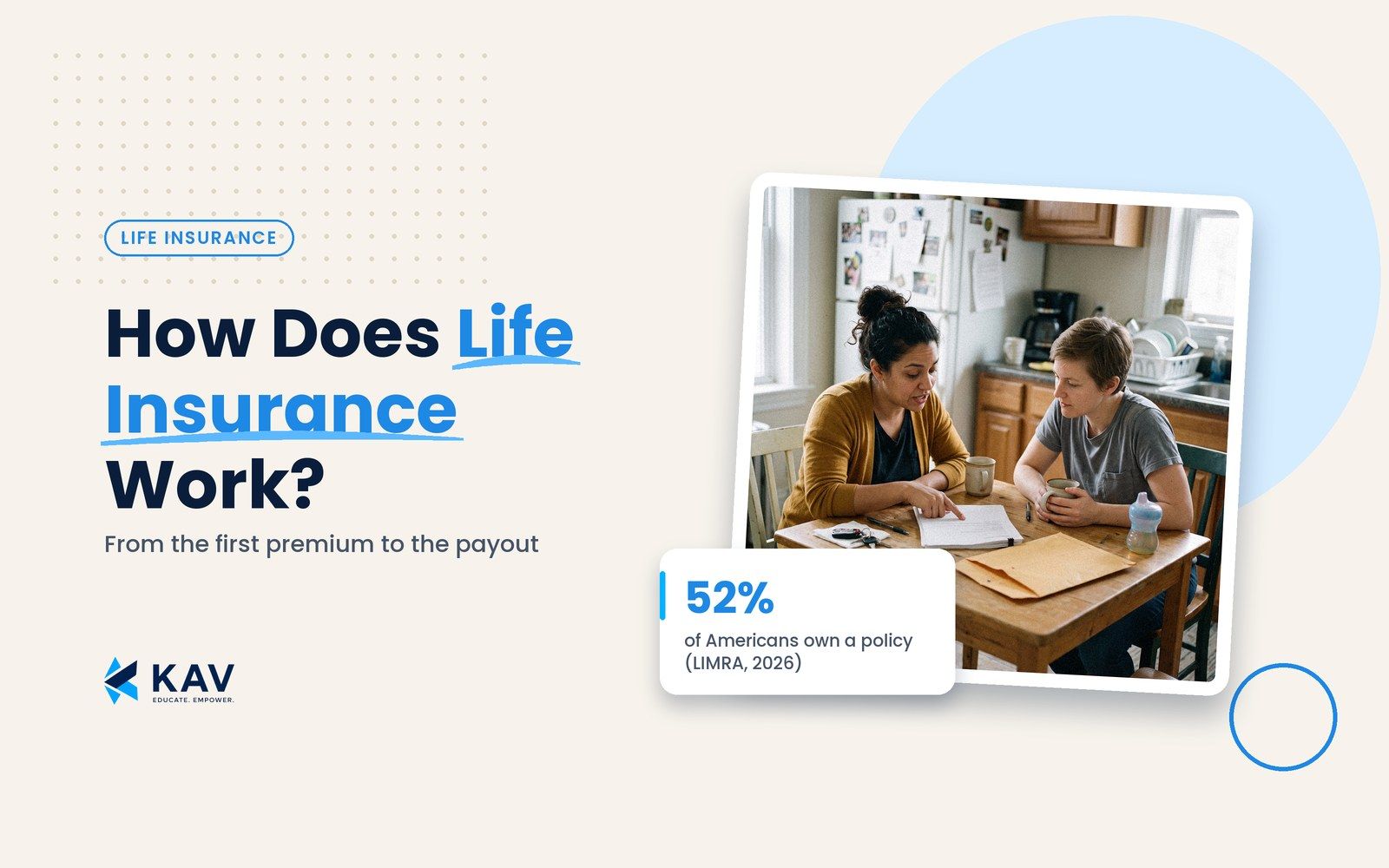
You're in good company. Just over half of Americans, 52%, own at least one policy, according to the 2026 Insurance Barometer Study by LIMRA and Life Happens. And many of the rules that decide whether a policy pays are set by state law.
The short answer: Life insurance is a contract. You pay premiums, and if you die while the policy is in force, the insurer pays a death benefit to the beneficiaries you named. Term insurance covers a set number of years; permanent insurance covers your whole life and builds cash value. To collect, your beneficiary files a claim with a death certificate, and under Internal Revenue Service rules the payout generally isn't taxable income.
Key takeaways
- Every policy has an owner, an insured person and a beneficiary, and its type decides how long it lasts: term for set years, permanent for life.
- A policy moves from application and underwriting to a free look of at least 10 days in Pennsylvania, then years of premiums, then a claim.
- In our examples, a $500,000 term policy pays in full, while a $250,000 whole life policy pays $218,100 after an unpaid loan and a late premium.
- Pennsylvania law gives a grace period of 30 days or one month and bars contesting a policy after two years, except for unpaid premiums.
- Work coverage over $50,000 counts as taxable wages, and regulators say it's usually less than you need and may not leave with you.
- The costliest mistakes: buying a policy as a retirement plan, letting it lapse early and canceling an old policy before the new one is in force.
What life insurance is, and the two main types
Life insurance is a contract that "pays a death benefit if you die while the policy is in effect, in exchange for premiums you pay before your death." That's the definition from the National Association of Insurance Commissioners (NAIC), the national group of state insurance regulators. Your family can use the money to replace your income, pay off debts or cover funeral costs.
Who's who on a policy
- The policyowner pays the premiums and makes the decisions: changing a beneficiary, borrowing against the policy or cashing it in.
- The insured is the person whose life is covered, usually the owner but not always. As Virginia's State Corporation Commission explains, if your spouse buys a policy on your life, "you are still the insured, but your spouse is the policyowner."
- The beneficiary receives the money. A contingent beneficiary is the backup if the first beneficiary has already died.
- The premium is what the owner pays to keep the coverage, monthly, quarterly or yearly.
- The death benefit, also called the face amount, is what the policy promises to pay.
Term life insurance
Term life covers you for a set number of years, called the term. According to the Pennsylvania Insurance Department, it "pays a death benefit only if you die during that term." Most term policies don't build cash value.
Most can be renewed when the term ends, at a higher premium each time. Many can also be converted to whole life before a deadline, "even if you are not in good health." Here's how converting term life insurance to whole life works.
Permanent life insurance
Permanent insurance lasts for the rest of your life, as long as the premiums are paid.
- Whole life keeps the same premium for life. The Pennsylvania Insurance Department notes that premium "may be several times higher" than you'd pay at first for the same amount of term coverage. Part of it builds cash value.
- Universal life puts your premiums, minus charges, into an account that earns interest, and the cost of the insurance comes out of it. Coverage lasts "as long as there is enough money in the account to pay the charges for the insurance."
Cash value is money the owner can borrow against, or take by surrendering (canceling) the policy, often minus a surrender charge. Our comparison of term vs. whole life insurance covers which tends to fit which family. Add-ons called riders change what a policy covers, and they can raise the premium.
How a life insurance policy works, step by step
A policy goes through the same stages for nearly everyone: you choose an amount, apply, receive the policy, pay premiums, and one day your beneficiary files a claim.
- Pick an amount and a type. Our guide to how much life insurance you need walks through the count.
- Apply and go through underwriting. The insurer asks about your health, job and habits to decide whether to cover you and what to charge. Depending on the company, "a medical examination may be required," says the Pennsylvania Insurance Department. Answer every question fully; a misstatement can put a future claim at risk.
- Use the free look. In Pennsylvania, you get at least 10 days after the policy arrives to review it. If you return it in that time, "Pennsylvania law requires that you be given a full refund."
- Pay premiums on time. A grace period keeps a late payment from ending your coverage. Once it runs out, the policy lapses.
- Get past the first two years. During this contestable period, the insurer can review your application if you die and challenge the claim over a material misstatement.
- Keep your beneficiaries current. The NAIC notes, "As the policy owner, you can change beneficiaries at no cost."
- The claim. The insurer doesn't send money on its own. The Washington State Office of the Insurance Commissioner lists what a beneficiary sends: a completed claim form, a certified copy of the death certificate, and the policy or a lost policy affidavit.
- The payout. The insurer confirms the policy was in force, the beneficiary is entitled, the age was right and whether a loan is outstanding. Then it pays, as a lump sum or, under some policies, in a series of payments. The Internal Revenue Service (IRS) says the proceeds "aren't includable in gross income," but "any interest you receive is taxable."
An example of each: term and whole life
These two people are illustrations, not KAV clients, and the numbers are round on purpose. Premiums are left out because they depend on the insurer, your age and your health.
Tanya's 20-year term policy
Tanya, 36, is a dental hygienist in Allentown, Pennsylvania, married with a 4-year-old son. In 2026 she buys a 20-year term policy with a $500,000 death benefit, naming her husband, Luis, as beneficiary.
- Year 9: Tanya dies at 45, well past the two-year contestable period.
- The claim: Luis sends the claim form, a certified death certificate and the policy.
- The payout: $500,000, none of it taxable income to Luis under IRS rules. Interest it earns afterward would be taxable.
- If Tanya had outlived the term: coverage would end when she turned 56. Virginia's regulator is blunt: "If you live past the end of the term, the policy will expire and will then have no value and pay no benefits."
A term policy pays its full face amount when the death falls inside the term, and nothing after it ends.
Marcus's whole life policy with a loan
Marcus, 50, is a self-employed electrician in Ohio with a $250,000 whole life policy. He borrowed $30,000 against its cash value during a slow year and never paid it back, and $1,500 of loan interest is unpaid too. He dies during the grace period, with a $400 premium still due.
- Death benefit: $250,000
- Minus the unpaid loan: $30,000
- Minus the unpaid loan interest: $1,500
- Minus the overdue premium: $400
- Paid to his beneficiary: $218,100
The face amount isn't always the check. Virginia's regulator says proceeds are figured "less any loans not repaid plus unpaid interest on those loans." After a death in the grace period, an insurer will also "usually" deduct the unpaid premium.
When a payout can be smaller, delayed or denied
Once the insurer has due proof of death, a policy that's in force pays. A few situations can still shrink, slow or stop the money.
- A death in the first two years. The Pennsylvania Insurance Department explains that during this contestable period, "a company may contest a claim on a policy because of material misrepresentations." After that, exclusions written into the policy still apply.
- Suicide in the first two years. Many policies include a suicide clause. If the insured dies by suicide within a set period, usually two years from the issue date, the insurer returns the premiums instead. If you're struggling, call or text 988 to reach the 988 Suicide & Crisis Lifeline anytime, day or night.
- A missed premium. If the insured dies during the grace period, the overdue premium can be subtracted from the payout. After the grace period, the policy lapses.
- A wrong age on the application. The benefit is adjusted to what the premiums paid "would have purchased at the correct age."
- An unpaid policy loan. It comes off the top, as in Marcus's example.
- A minor as beneficiary. The NAIC is direct: "Insurance companies won't pay a minor." Here's what to do when a minor is your life insurance beneficiary.
Pennsylvania's rules, and how other states differ
Pennsylvania writes these protections into its Insurance Company Law, 40 P.S. § 510. For most life policies delivered in the state, it requires:
- A grace period "either of thirty days or one month" for premiums due after the first year.
- Incontestability after two years from the issue date, "except for nonpayment of premiums."
- Reinstatement of a lapsed policy within three years, if you show you're still insurable and pay the overdue premiums with interest.
Other states set their own versions. Washington requires a 31-day grace period. Its insurance commissioner says insurers "must pay your beneficiary no less than 8 percent interest starting from the date of death," and adds 3% more for claims not settled within 90 days of proof of death.
How life insurance through work is different
Group life insurance through your job pays a claim the same way. The difference is that your employer holds the contract, and you may not be able to keep it when you leave. You get a certificate of coverage, not a policy of your own.
Plenty of people rely on it alone: 27% of Americans with life insurance have only workplace coverage, according to the 2026 Insurance Barometer Study. Three things set it apart:
- It's usually not enough. The NAIC's guide says that with coverage through your employer, "the death benefit usually is less than you need."
- It may not follow you. "If you leave the employer, you may not be able to take this coverage with you," the guide adds. Ask HR whether you can convert or keep it before you change jobs.
- Coverage over $50,000 adds taxable wages. IRS Publication 15-B tells employers they "must include in your employee's wages the cost of group-term life insurance beyond $50,000 worth of coverage." The death benefit itself still generally isn't taxed.
Work coverage is a fine, often low-cost starting point. Count it as one piece; our comparison of group vs. individual life insurance shows how families combine the two.
Common mistakes, and what a sales pitch sounds like
These five mistakes show up again and again in the questions families post online about policies they bought or were pitched.
Buying a policy as a retirement plan
Some pitches present whole or universal life as a replacement for a 401(k). Virginia's regulator answers that directly: "the main purpose of life insurance is financial protection." Other products exist for goals like retirement or college.
If someone shows you projected cash values, the NAIC suggests asking, "What part of the premium or policy value isn't guaranteed?" Also ask "the highest premium you'd have to pay to keep your coverage." Anyone selling variable life insurance must also be registered with a broker-dealer licensed by the Financial Industry Regulatory Authority (FINRA), Virginia's guide notes.
Letting it lapse in the early years
"Don't buy life insurance unless you intend to maintain the policy," the Pennsylvania Insurance Department warns. "It can be very costly if you stop paying premiums during the early years of the policy." Pick a premium you could still pay in a lean year.
Expecting money back from a term policy
A term policy that expires usually pays nothing and returns nothing. The NAIC calls term "lower cost coverage for a specific period of time." It's protection for those years, not savings.
Not telling anyone the policy exists
Your beneficiary has to file the claim. If nobody knows which company holds the policy, the money can sit unclaimed while your family searches.
Canceling an old policy before the new one is in force
The NAIC's advice is plain: "Don't cancel your current policy until you get the new one." A replacement can also restart the clock; Washington's guide warns it may carry "a new two-year suicide clause."
A good conversation about life insurance starts with your family's numbers: what you owe, what you earn and who depends on you. If it starts with a product and a projected return, slow down and ask for everything in writing.
Where to start this week
- Find every policy you have, including the one at work. Note the insurer, policy number, owner, beneficiaries, face amount, and whether it's term (with its end date) or permanent.
- Check your beneficiaries. Make sure they're current, add a contingent beneficiary, and don't name a minor directly.
- Tell your beneficiary where the paperwork is. The company name and policy number are enough to start a claim.
- Put premiums on autopay. Then look up your grace period.
- If you're applying, answer every question fully. Read the policy during the free look.
- If you own a policy you don't understand, read it line by line. Our guide to reviewing your life insurance policy lists what to check.
- Count what your family would need, then compare it with what you have.
If you would like help turning this into a plan, KAV Solutions offers a complimentary Financial Needs Analysis. A licensed insurance professional walks through how much coverage your family would need, which type fits, and how it lines up with the coverage you already have through work. The analysis is free and you never pay KAV a fee. If you choose to buy a policy, the insurer pays the professional a commission. For tax decisions, bring the numbers to a tax professional.
Frequently asked questions
How long does a life insurance payout take?
There's no single national deadline. Virginia's insurance regulator says that if everything is in order, "the beneficiary usually can get the money soon after notifying the company and furnishing proof of death." A death in the first two years can take longer while the insurer reviews the application. Some states add interest, too; in Washington, it runs from the date of death.
Can you have more than one life insurance policy?
Yes. Many families combine a group policy at work with one they own. The Pennsylvania Insurance Department notes you can buy whole life insurance for lifetime coverage "and add term insurance for the period of your greatest insurance need." Each policy pays under its own terms, so count them all.
Who can you name as a life insurance beneficiary?
A person, several people, or an organization such as a charity or a trust. The NAIC's buyer's guide says you'll need each beneficiary's Social Security or tax identification number. Because "insurance companies won't pay a minor," it suggests leaving money meant for a child to your estate or a trust.
Can you change your beneficiary later?
Usually, yes, and it's free. The NAIC says the policy owner "can change beneficiaries at no cost" and suggests reviewing them every few years and after big life events. Only the owner can make the change, so if a spouse or ex-spouse owns a policy on your life, that person decides.
Do you need life insurance if no one depends on your income?
Often less, and sometimes none. Virginia's regulator puts it simply: "the fewer dependents you have, the less life insurance protection you are likely to need." Some people still want enough for final costs or to leave money to a relative or a charity. If you pay for extra coverage at work, weigh its cost against that need.
Can you cash out a life insurance policy?
Only a permanent policy with cash value. The owner can surrender it for that cash value, and the insurer may subtract a surrender charge first. The coverage ends when you do. Term policies usually have no cash value. Before surrendering an older policy, ask the insurer for a current statement of its values.
KAV Solutions is a women-led team of licensed insurance professionals based in Pennsylvania. This article is general education, not individualized financial, tax, or legal advice. Policy provisions, coverage availability, underwriting, and pricing vary by insurer and state.