Spend a few minutes in any online money forum and the same story comes up. Someone bought whole life insurance years ago, often after a persuasive pitch, and now wonders whether to drop it for term. One camp replies that whole life is always a rip-off. The other says term is money wasted if you outlive it.
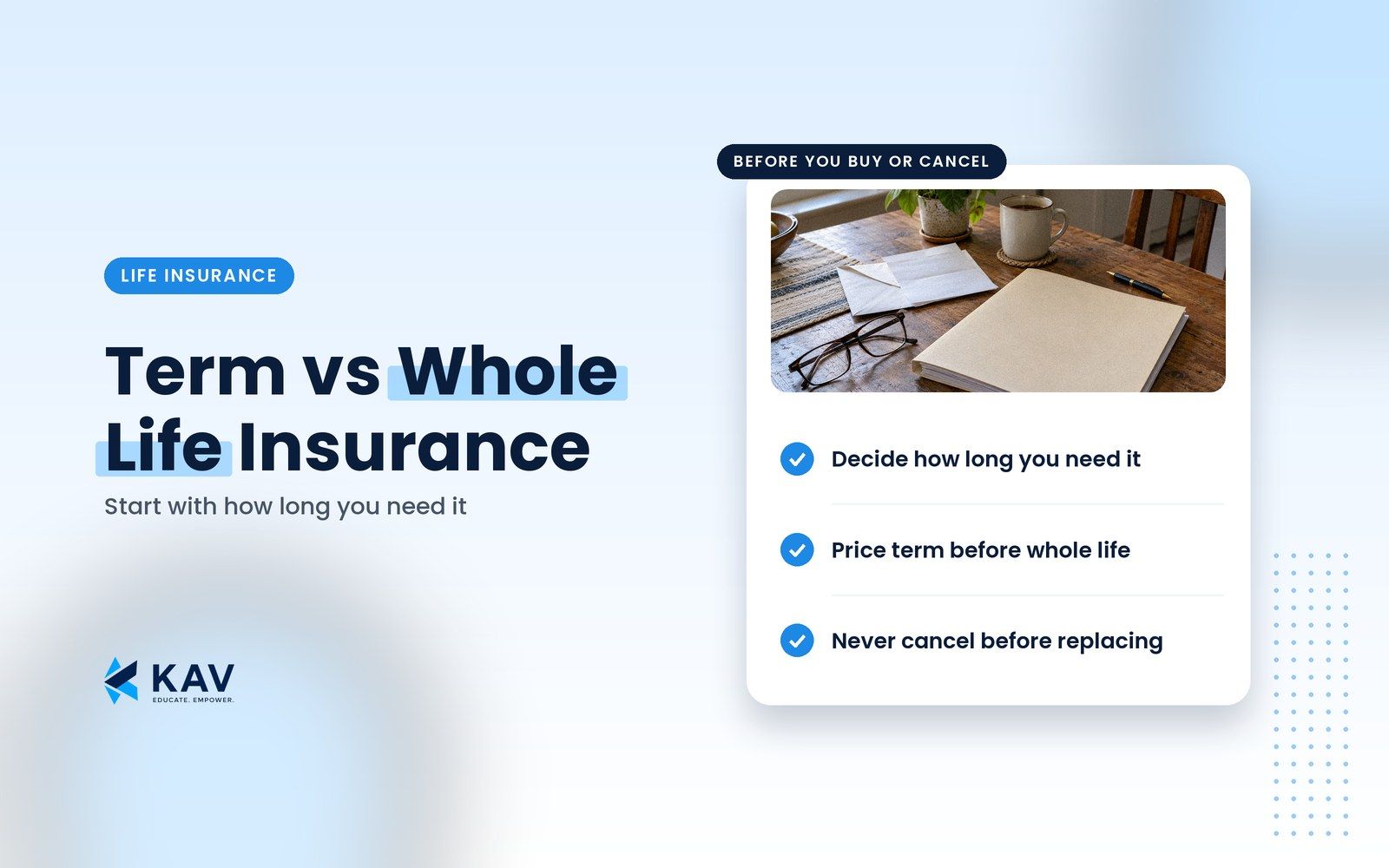
Both are too simple. The Louisiana Department of Insurance's buyer's guide puts the first step plainly: decide how much coverage you need "and for how long." That second part settles term vs whole life insurance for most families.
The short answer: Term life insurance covers you for a set number of years and, as the Louisiana Department of Insurance puts it, "generally offers the largest insurance protection for your premium dollar." Whole life covers you for as long as you live, provided the premiums are paid, and builds cash value, but its premiums can start "several times higher" than term for the same coverage, according to the Louisiana Department of Insurance. If your need ends when the children are grown, term fits. If it lasts a lifetime, whole life can.
Term vs whole life insurance: what is the difference?
Term life insurance pays only if you die during the period you buy, such as 10 or 20 years. Whole life insurance pays whenever you die, as long as the premiums are paid (Louisiana Department of Insurance).
The other differences follow from that:
- Premiums. Whole life premiums generally stay the same for life. Term starts lower, but "each time you renew the policy for a new term, premiums may be higher," the Louisiana guide warns.
- Cash value. Term "generally does not build up cash value." Whole life does, and you can borrow against it. The catch: unpaid loans and interest "will be subtracted from the benefits when you die, or from the cash value."
- Dividends. "Participating" whole life policies may pay dividends. Dividends are not guaranteed and can change every year, so any dividends shown in an illustration are projections, not promises (Louisiana Department of Insurance).
- Taxes on the payout. For both, the Internal Revenue Service (IRS) says death benefits paid to a beneficiary generally "aren't includable in gross income," although any interest paid on the proceeds is taxable (IRS).
Which costs less, term or whole life?
For the years most families need coverage, term costs far less. The Louisiana guide says whole life premiums "can be several times higher than you would pay initially for the same amount of term insurance."
Over a whole lifetime, the gap narrows. Those level whole life premiums "are smaller than the premiums you would eventually pay if you were to keep renewing a term policy until your later years." Term is cheap for a defined window and expensive to keep forever. Whole life is expensive up front and predictable after that.
Many people never compare at all. In the 2025 Insurance Barometer Study by Life Happens and LIMRA, about three-quarters of adults overestimated the true cost of life insurance. In the 2026 study, 52% of adults surveyed owned coverage and 29% said they needed coverage they did not have (LIMRA). Price a term policy before you decide anything.
How long does your family need the coverage?
Start with what the insurance has to pay for, then ask when each need ends.
Term usually fits when the need has an end date:
- replacing your income until the children can support themselves
- paying off a mortgage
- covering childcare, or replacing a stay-at-home parent's work, while the children are small
- paying for college
Whole life can fit when the need lasts a lifetime:
- a dependent who will need support for life, such as an adult child with a disability
- money your heirs will need to settle an estate, whenever that happens
- final expenses you want covered however long you live
- you already save the most you can in retirement accounts and want a death benefit that lasts for life
Some families need both: a larger term policy for the child-raising years and a smaller permanent one for lifelong costs. Unsure whether a lifelong need will appear? A convertible term policy keeps the door open: it lets you exchange the term policy for a permanent one without new health questions, usually by a deadline set in the policy. Our guide to converting term life insurance to whole life shows where to find that deadline.
To size the term policy, our guide to life insurance for a stay-at-home mom walks through the math. If your only coverage today comes with your job, first check whether life insurance through work is enough, because it usually ends when the job does.
Already own whole life? Five checks before you cancel
If you were sold whole life and now suspect term would have served you better, canceling can still be the wrong move. The Louisiana guide's advice comes down to five checks:
- Get the new coverage in force first. "If you decide to replace your policy, don't cancel your old policy until you have received the new one." And if your health has changed, "You will not be able to buy a new policy if you are not insurable."
- Work out what the cash value is worth after tax. Under IRS Publication 525, if you surrender a policy for cash, anything above your cost (generally the premiums you paid, less dividends and similar amounts) counts as income.
- Ask about options inside the policy. You may be able to use the cash value "to keep insurance protection for a limited time or to buy a reduced amount without having to pay more premiums," so you stop paying without losing all coverage.
- Consider a tax-free exchange before cashing out. Federal law lets you exchange one life insurance contract for another, or for an annuity, without recognizing a gain (26 U.S.C. 1035). The rules are technical, so involve a tax professional.
- Ask the insurer for an in-force illustration. It shows the policy's guaranteed values next to its current non-guaranteed projections, so you can compare keeping it with any replacement on the same basis. Our guide on how to review your life insurance policy covers what to look for.
One cost is already behind you. Much of what you paid in the first years covered the insurer's cost of selling and issuing the policy, and "You may pay this type of cost again if you buy a new policy." That is a reason not to swap one whole life policy for another. It is not a reason to keep paying for coverage you no longer need.
Where to start this week
Write down what your life insurance has to pay for and the year each need ends. If every need has an end date, price term first. If one lasts a lifetime, that piece is where permanent coverage belongs.
A sound review starts with what your family owes, earns and needs, so ask how any recommendation was reached before you act on it. Our explainer on what a financial needs analysis covers shows what a proper review asks first.
If you would like help turning this into a plan, KAV Solutions offers a complimentary Financial Need Analysis. A licensed insurance professional walks through how much coverage your family needs, for how long, and whether a policy you already own still fits. The analysis is free and you never pay KAV a fee. If you choose to buy a policy, the insurer pays the professional a commission.
Frequently asked questions
What happens when a 20-year term life policy ends?
The coverage stops, and nothing is paid if you die afterward. Many term policies can be renewed even if your health has changed, but "each time you renew the policy for a new term, premiums may be higher." Some can also be converted to permanent insurance during a conversion period. Check both rights in your policy well before the term ends.
Can you have term and whole life insurance at the same time?
Yes. Nothing stops you from owning both, and pairing them can match coverage to needs: a larger term policy for the years children depend on you, and a smaller whole life policy for costs that last a lifetime, such as final expenses.
Can I get money back if I cancel whole life insurance?
Usually you receive the policy's cash value, less any unpaid loans. In the first years it can be small; the Louisiana guide warns a policy "may be very costly if you quit during the early years." Anything you receive above your cost in the policy (generally the premiums you paid minus any dividends, refunds or rebates you received) is taxable income, according to IRS Publication 525.
Is whole life insurance a good idea for a child?
The main reason to buy life insurance, the Louisiana guide says, is "to cover the financial effects of unexpected or untimely death," and most children have no income anyone depends on. A small whole life policy bought for a child stays in force for life as long as the premiums are paid. If the real goal is saving for the child, compare it with accounts built for that, such as those in our Trump account vs 529 plan guide.
KAV Solutions is a women-led team of licensed insurance professionals based in Pennsylvania. This article is general education, not individualized financial, tax, or legal advice. Coverage availability, underwriting limits, and pricing vary by insurer, state, and province.