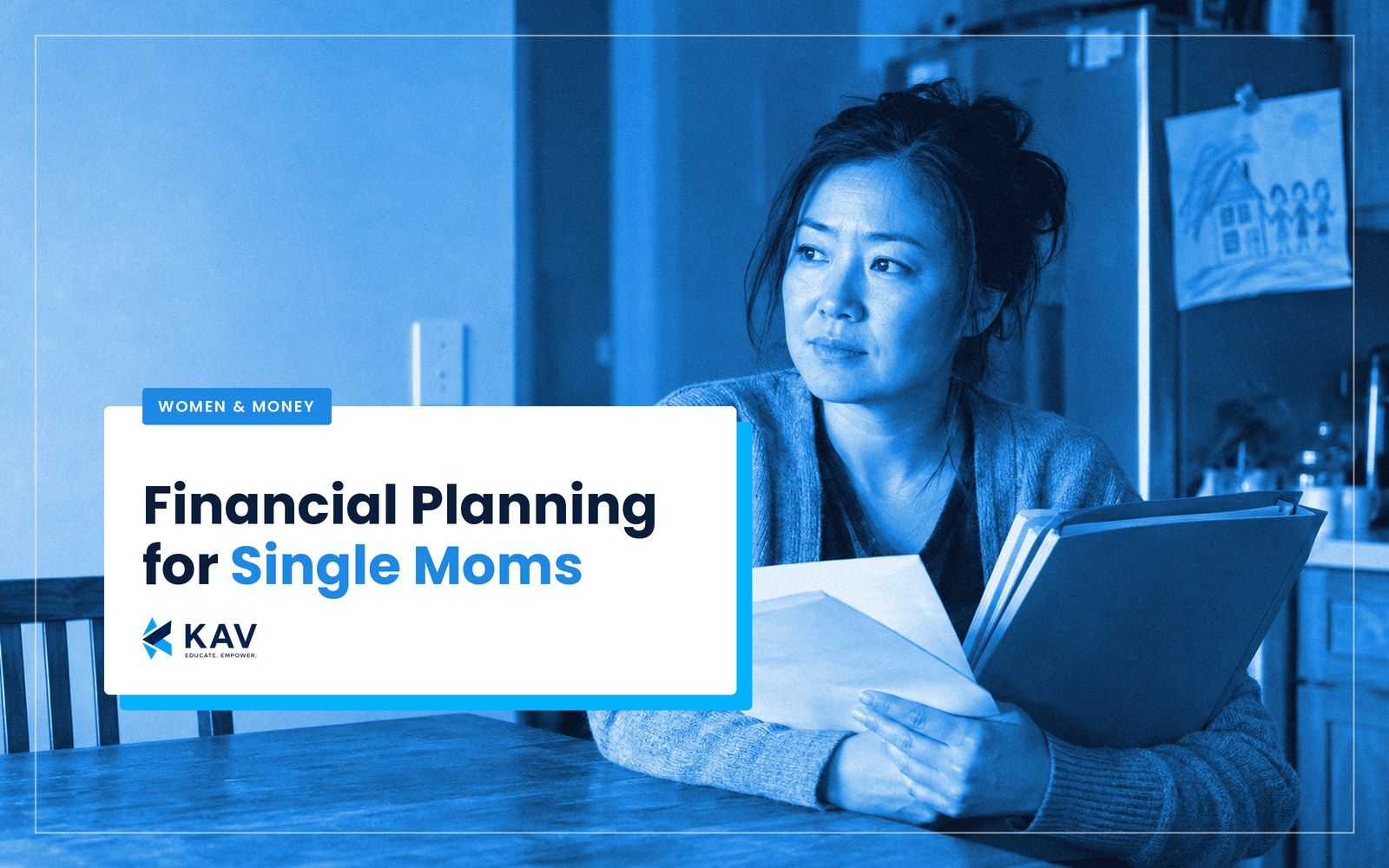
You're the only paycheck. You're also the name on every school form and the person who handles the car, the bills and the what-ifs. Financial planning for single moms isn't a different kind of plan. It's the usual plan with no backup built in, so you have to put the backup on paper yourself. The good news? Most of it fits on a short list, and part of it can put money back in your pocket at tax time.
The short answer: Plan in layers: a cash cushion sized for one income, insurance that replaces your paycheck if you can't earn it, and paperwork that names who raises your kids and manages their money. Then claim the tax breaks single parents get. For 2026, the Internal Revenue Service (IRS) sets the head of household standard deduction at $24,150, versus $16,100 for single filers.
Key takeaways
- Build the budget on your paycheck alone, and treat child support as extra money, not the base.
- Coverage through work usually ends with the job, and 27% of insured Americans have only workplace coverage (LIMRA, 2026).
- A will that names a guardian, plus beneficiary forms that don't leave money straight to a minor, keeps you in charge of what happens next.
- At tax time, check head of household status, the Child Tax Credit (up to $2,200 per child) and the care credit, which grew for 2026.
This week: build a budget around one paycheck
Start with the money you can count on every month: your take-home pay. Everything else in the plan sits on top of that number.
- List the must-pays. Rent or mortgage, utilities, groceries, childcare, the car, insurance and minimum debt payments. That's your floor.
- Treat child support as a bonus, not the base. If a payment's late or stops, your paycheck still has to cover the must-pays. Put support toward savings, the kids' extras or debt instead.
- Build a cushion for one income. There's no second paycheck to lean on, so the cushion does that job. Our guide to how much should be in an emergency fund shows how to size it; one month of must-pays is a solid first goal.
- Make saving automatic. A small transfer that leaves on payday, before you see it, beats a big plan you redo every month.
If you've never written a budget, our guide to making a budget for beginners walks through it in an evening.
This month: protect the paycheck your kids depend on
Your income is the biggest thing your family has, so the next step is coverage that replaces it if you die or can't work.
Life insurance
Coverage through work counts, but it usually belongs to the job. In LIMRA and Life Happens' 2026 Insurance Barometer Study, 27% of people with life insurance had coverage only through work. Our guide to group vs individual life insurance explains what happens to it when you change jobs.
Skip the rules of thumb for how much. Add up what your kids would need until they're grown (housing, childcare, school, any debts you'd leave behind), then subtract what you already have. That's exactly what a financial needs analysis does.
Disability coverage
Life insurance pays if you die. Disability coverage replaces part of your pay if an illness or injury keeps you from working, and in a one-income home, that paycheck is the whole budget. Open your employer's benefits portal and look for short-term and long-term disability: whether you have it, and what share of your pay it replaces.
This month: put your kids' guardian and money on paper
Writing down your choices is how you keep a say in who raises your kids and who handles their money if you can't.
- Name a guardian in a will. Pick the person, ask them, and pick a backup. Our guide to choosing a guardian for your child covers how to decide.
- Don't leave money straight to a minor. Our guide on whether a minor can be a life insurance beneficiary explains the better options, from a custodian to a trust.
- Check every beneficiary form. Your 401(k), your life insurance at work, any policy of your own and any bank account with a payable-on-death name. If an ex is still listed and no court order requires it, update the form. Our guide to finances after divorce explains why the decree alone doesn't change it.
- Add a power of attorney. It names who can pay your bills if you're alive but can't act. See financial vs medical power of attorney.
At tax time: claim what single parents qualify for
Single parents can qualify for a better filing status and several credits, and missing them costs real money.
- Head of household. You generally qualify if you're unmarried on the last day of the year, you paid more than half the cost of keeping up your home, and a qualifying person "lived with you in the home for more than half the year" (IRS Publication 501). For 2026, the standard deduction is $24,150, compared with $16,100 for single filers (Internal Revenue Service).
- Child Tax Credit. It's "worth up to $2,200 per qualifying child" under 17 at the end of the year, with the full credit available up to $200,000 of income (IRS).
- Earned Income Tax Credit. For 2026, the maximum is $8,231, for families with three or more qualifying children.
- Child and Dependent Care Credit. For kids under 13, it's 20% to 50% of up to $3,000 in care costs for one child, or $6,000 for two or more, depending on your income. The IRS says the credit increased beginning in 2026.
- Dependent care flexible spending account (FSA). If your employer offers one, the federal limit rose to $7,500 starting in 2026 (26 U.S. Code 129). You sign up during open enrollment.
Example: what that can add up to
Take Jenna, 36, a dental hygienist in Columbus, Ohio, with two kids, ages 6 and 9. She's an example, not a client.
- Child Tax Credit: up to $4,400 (2 x $2,200), if her income is under the limit.
- Care credit: if after-school care costs her $6,000 or more, 20% to 50% of $6,000, or $1,200 to $3,000, depending on her income.
- Filing status: head of household instead of single raises her 2026 standard deduction by $8,050.
How the FSA and the care credit work together depends on her return, so that's a question for a tax professional.
Financial planning for single moms: start this month
- Write down your take-home pay and your must-pays, and see the gap between them.
- Open your benefits portal: check your life coverage, your disability coverage and whether there's a dependent care FSA.
- Pull up every beneficiary form and read the names.
- Choose a guardian and a backup, then book time with an estate-planning attorney for your will.
- Before you file your 2026 return, confirm your filing status and credits with a tax professional.
If you'd like help turning this into a plan, KAV Solutions offers a complimentary Financial Needs Analysis. A licensed insurance professional walks through how much protection one income needs, and what you already have through work, with you. The analysis is free and you never pay KAV a fee. If you choose to buy a policy, the insurer pays the professional a commission. KAV's professionals aren't attorneys or tax preparers: your will belongs with an estate-planning attorney in your state, and your tax return with a tax professional.
Frequently asked questions
Do single moms get free health insurance for their kids?
Your kids may qualify for low-cost or free coverage through the Children's Health Insurance Program (CHIP). Under CHIP, "routine 'well child' doctor and dental visits are free," and you won't pay more than 5% of your family's income for the year, according to HealthCare.gov. Each state sets its own rules, and you can apply any time of year.
Can I file head of household if my kids live with me half the time?
Not if it's exactly half. The IRS test is that a qualifying person lived with you for more than half the year. Custody schedules get complicated, especially with holidays and summers, so check yours with a tax professional before you file.
Would my kids get Social Security if I died?
They may. Children can get survivor benefits if they're unmarried and 17 or younger, 18 or 19 and in school (K-12) full time, or any age if their disability began at 21 or younger, according to the Social Security Administration. A family's total is capped by a "family maximum," and some minor children can also get a one-time $255 payment (SSA). Count it as a floor, not a replacement for your paycheck.
KAV Solutions is a women-led team of licensed insurance professionals based in Pennsylvania. This article is general education, not individualized financial, tax, or legal advice. Tax figures are for the 2026 tax year, and guardianship and estate rules vary by state.