Ask how much should be in an emergency fund and you will hear "three to six months of expenses" almost every time. It is good advice with one problem: the top of that range is double the bottom. For a family spending $5,000 a month on the basics, that is the difference between $15,000 and $30,000.
Most families are not there yet. According to the Federal Reserve's 2025 survey of household finances, 55% of American adults had set aside three months of expenses in an emergency fund. Another 15% said they could cover three months only by borrowing, selling assets or drawing on other savings.
This guide shows you how to pick your own number of months, which expenses to count, what one family's target looks like with the math shown, and where the money should live.
The short answer: Hold three to six months of essential expenses (housing, food, utilities, transportation, insurance and minimum debt payments). Choose three with two steady incomes, and six or more with one income, children, or commission or self-employed pay. In September 2026, the median unemployed American had been out of work for 11.5 weeks, and 27.1% of unemployed people for 27 weeks or more (BLS).
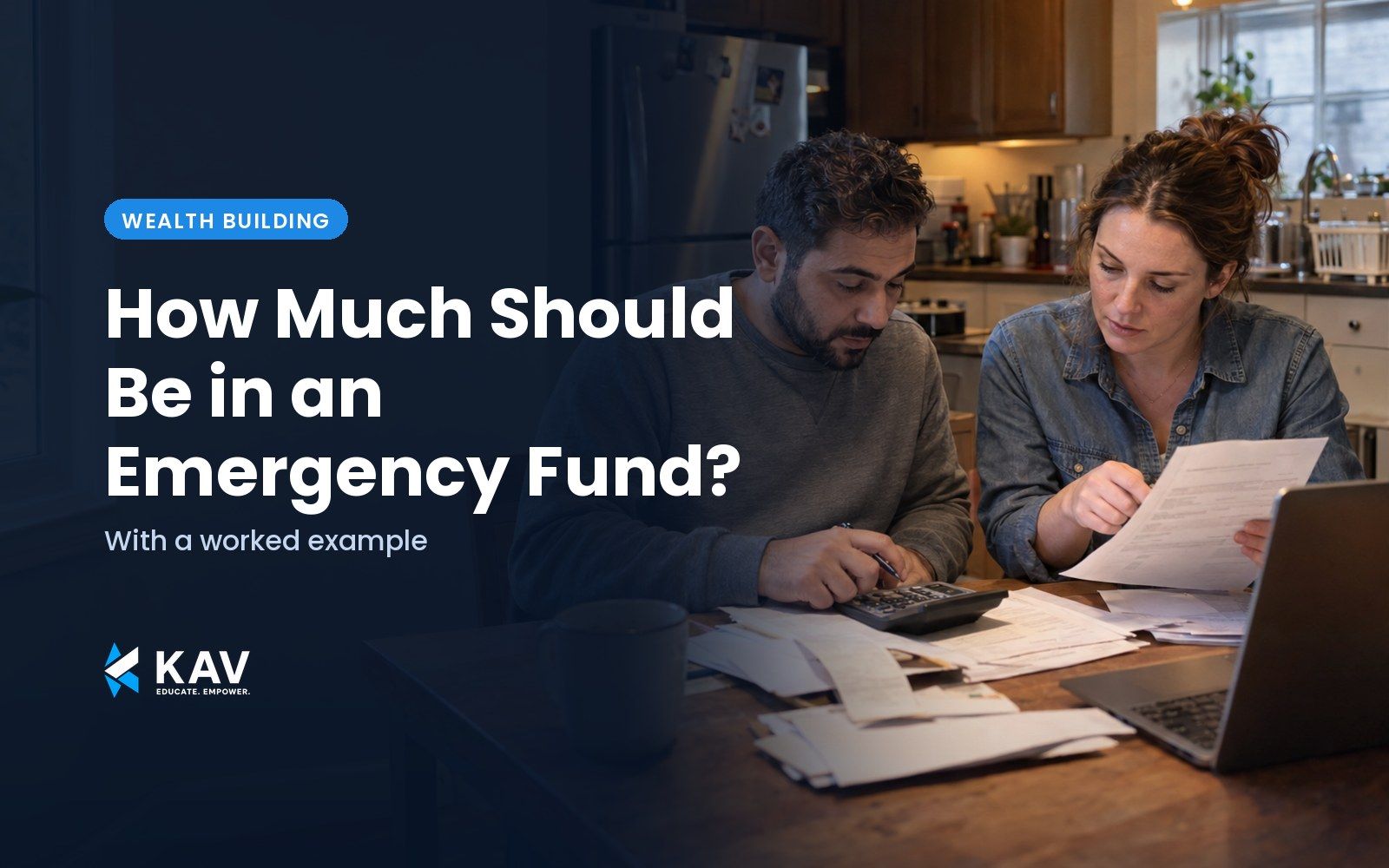
How much should be in an emergency fund?
Most households should keep three to six months of essential living expenses in cash, built in two stages: a starter fund that covers a single surprise bill, then the full target that covers a lost paycheck. Essentials means what you must pay to keep the household running, not your full monthly spending.
The starter fund matters because emergencies are common. In the Fed's survey, 59% of adults had at least one unexpected expense in the prior 12 months. The most common were a major car repair or replacement (30%), a major home or appliance repair (22%) and unexpected medical bills (21%). The median cost of each, among people who knew the amount, was $1,000 to $1,999.
So a practical first milestone is about $2,000, enough to cover the top of that range. It turns a broken transmission into an annoyance instead of a credit card balance.
The full fund is a different job. It replaces income while you look for work, recover from an illness, or wait for a business to pick up again. That is why it is measured in months rather than dollars, and why your number depends on how fragile your income is.
Why three to six months? What the job data says
The range comes from how long it takes to replace a paycheck, and the latest numbers support both ends of it. The Bureau of Labor Statistics reported that in September 2026 the median unemployed person had been looking for 11.5 weeks, a little under three months. The average was 24.8 weeks, close to six.
The average sits so far above the median because a large group stays unemployed for a long time. About 1.9 million people, 27.1% of everyone unemployed, had been out of work for 27 weeks or more. Three months covers a typical search. Six months covers you if your search turns out to be one of the long ones.
Unemployment insurance helps, but it is not a full replacement. According to the U.S. Department of Labor, benefits are based on a percentage of your earnings over a recent 52-week period, up to a state maximum, and last a maximum of 26 weeks in most states. You also have to be unemployed through no fault of your own. If you are self-employed or paid mostly on commission, check your state's rules before counting on it.
How to choose your number of months
Start at three months and add one month for every risk factor that applies to your household. The steps below take about 15 minutes with last month's bank statement.
- Add up your monthly essentials. Use the list in the next section.
- Start at three months. That covers a typical job search for a household with two steady incomes.
- Add one month if one income covers most of the bills, including if you are single.
- Add one month if children or another adult depend on you.
- Add one month if your pay is commission, seasonal, freelance or self-employed.
- Add one month if your field or seniority means long searches, or if you own an older home or car.
- Multiply your essentials by your months. That is your target.
Most families land between three and six months. If several factors apply, especially self-employment with children, going beyond six is reasonable.
Which expenses count toward your emergency fund?
Count only what you would still have to pay if your income stopped tomorrow:
- Rent or mortgage, including property tax and homeowners or renters insurance
- Groceries and basic household supplies
- Utilities, phone and internet
- Car payment, gas, car insurance or transit
- Childcare you would still need while job hunting
- Health insurance premiums and regular prescriptions
- Minimum payments on every debt
- Life and disability insurance premiums, so existing coverage stays in force
Leave out restaurants, vacations, subscriptions you would cancel, extra debt payments and retirement contributions. If your health coverage comes through work, find out what keeping it would cost if you left the job, and use that figure instead of your paycheck deduction.
A worked example: Omar and Kelly
Omar and Kelly have two children, ages 4 and 7. Omar earns a salary; most of Kelly's pay is sales commission. These figures are illustrative, so use your own bills.
Monthly essentials:
- Mortgage, property tax and homeowners insurance: $1,850
- Groceries and household basics: $900
- Utilities, phones and internet: $420
- Car payment, gas and car insurance: $650
- Preschool and after-school care: $900
- Health insurance premiums and prescriptions: $380
- Minimum payments on a student loan and a credit card: $250
- Life and disability insurance premiums: $110
Total essentials: $1,850 + $900 + $420 + $650 + $900 + $380 + $250 + $110 = $5,460 a month
Months: 3 to start, plus 1 for two children, plus 1 for commission pay = 5 months. Their incomes are similar, so the one-income month does not apply.
Target: $5,460 × 5 = $27,300
They already have $6,000 saved, so the gap is $27,300 − $6,000 = $21,300. Saving $900 a month closes it in about 24 months ($21,300 ÷ $900 = 23.7). A tax refund or bonus added to the fund shortens that.
Notice what the rule of thumb would have told them: "three to six months" means anything from $16,380 to $32,760. Working through their own risks gives them one number to aim at, and a date.
Where should you keep your emergency fund?
Keep it somewhere safe, separate from your checking account and available within a day or two: a savings account or money market deposit account at an insured bank or credit union. Interest is a bonus. Access and safety come first. If you are choosing between those two account types, here is how a high-yield savings account compares with a money market account, and why a money market fund is a different thing.
- Insured savings. The FDIC insures $250,000 per depositor, per insured bank, for each account ownership category, including savings and money market deposit accounts. The NCUA gives federally insured credit union accounts the same $250,000 protection.
- CDs for the outer layer. Certificates of deposit are also insured, but early withdrawal usually costs you interest, so keep the first few months in plain savings.
- Not the stock market. Job losses and market drops can arrive together, and that is exactly when you would be forced to sell low.
- Not your 401(k) or IRA. The IRS charges an additional 10% tax on most withdrawals before age 59½, on top of income tax. Since 2024, one emergency withdrawal of up to $1,000 a year can skip the 10% tax, but you cannot take another from the same plan or IRA for the next three calendar years unless you repay it or contribute at least that amount back (IRS Notice 2024-55). That makes it a last resort, not a plan.
Emergency fund, debt or investing: what comes first?
A common order is: the $2,000 starter fund first, then high-interest debt while still building the fund, then the full target. Keep making every minimum payment throughout. Many planners also suggest keeping any employer retirement match while you save.
The fund also protects your other goals. Without it, a broken-down car can mean pausing retirement contributions or dipping into a college account. If you are weighing a Trump account vs a 529 plan for your children, the emergency fund is what keeps that money invested.
What an emergency fund cannot cover
An emergency fund is built for months. A long disability or the death of a parent can affect a family's finances for years, longer than most savings can cover. Life and disability insurance are designed for that kind of risk.
If you are not sure your coverage matches your family's needs today, our guide on how to review your life insurance policy walks through it step by step. The emergency fund, the insurance and the debts all belong in one picture, which is what a financial needs analysis puts together.
Are you in Canada? Here is what changes
The math is the same, but where you hold the money and what the government replaces are different.
- Deposit insurance. The Canada Deposit Insurance Corporation insures eligible deposits at member institutions up to $100,000 per category, including principal and interest. Joint deposits and TFSAs are separate categories. Mutual funds, stocks and ETFs are not covered.
- A TFSA can hold it. A high-interest savings account inside a TFSA earns interest tax-free. The 2026 TFSA dollar limit is $7,000. If you withdraw, the room comes back on January 1 of the following year, not right away.
- Employment Insurance. EI regular benefits pay most people 55% of average insurable weekly earnings, up to $729 a week in 2026. If you earn more than the $68,900 maximum insurable earnings, EI replaces a smaller share of your pay, so lean toward more months.
5 mistakes families make
- Using total spending instead of essentials. It inflates the target until it feels impossible, and many people never start.
- Counting a credit card as the fund. A card limit can be cut, and borrowing during a job loss adds a bill you will pay later.
- Keeping it in checking. Money you can see every day gets spent on things that are not emergencies.
- Never updating the number. A new baby, a new mortgage or a switch to self-employment changes your months and your essentials.
- Not refilling it. After you use the fund, rebuilding it becomes your next savings goal before anything new.
Your next step
Tonight, open last month's bank statement and circle every essential payment. Add them up, choose your months with the steps above, and write the target on a sticky note where you will see it. If you are not sure where the monthly savings will come from, our guide to how to make a budget for beginners walks through finding it, with one family's numbers.
If you would like help turning it into a plan, KAV Solutions offers a complimentary Financial Need Analysis. A licensed insurance professional walks through your essential expenses, your emergency fund target, and how your savings, debts and insurance fit together. The analysis is free and you never pay KAV a fee. If you choose to buy a policy, the insurer pays the professional a commission.
Frequently asked questions
How many months should an emergency fund cover?
Three to six months of essential expenses for most households. Choose three with two steady incomes, then add a month each for one main income, dependants, commission or self-employed pay, or a field with long job searches. In September 2026, the median unemployed person had been looking for 11.5 weeks, but 27.1% had been looking for 27 weeks or more (BLS).
How much emergency fund should a single person have?
Without a second income to fall back on, a single person should usually hold at least four months of essentials. With $3,000 of monthly essentials and a steady salary, that is $12,000. Add a month, to $15,000, if your income is irregular or comes from commission or freelance work.
Is $10,000 a good emergency fund?
It depends on your essential expenses. For a single person spending $3,000 a month on essentials, $10,000 covers about 3.3 months, which is a solid fund. For a family of four spending $5,460 a month, it covers about 1.8 months, a strong start that is still short of the three-month minimum.
Should I build an emergency fund before paying off debt?
Build a starter fund of about $2,000 first, which covers the typical major car, home or medical surprise, while making every minimum payment. Then split extra money between high-interest debt and the rest of the fund. Without any cash, the next surprise usually goes on a credit card and adds to the debt.
How much should a retiree keep in an emergency fund?
A retiree is not protecting a paycheck, so the job-search math does not apply. The risks are large repairs, medical bills and having to sell investments in a down market. A retiree's cash cushion is usually sized to the gap between guaranteed income, such as Social Security or a pension, and planned spending.
Where should I keep my emergency fund?
In a savings or money market deposit account at an FDIC-insured bank or NCUA-insured credit union, where it is protected up to $250,000 per ownership category (FDIC, NCUA) and available within a day or two. In Canada, a high-interest savings account at a CDIC member, possibly inside a TFSA, does the same job.
KAV Solutions is a women-led team of licensed insurance professionals based in Pennsylvania. This article is general education, not individualized financial, tax, or legal advice. Unemployment and Employment Insurance rules vary by state and province.