You looked up the average 401(k) balance for your age, and your number came up short. Before you panic, check which number you're comparing yourself to. The average 401(k) balance by age gets pulled up by a small group of very large accounts, so most savers sit below it. The median, the saver right in the middle, is the fairer yardstick, and it's a lot lower.
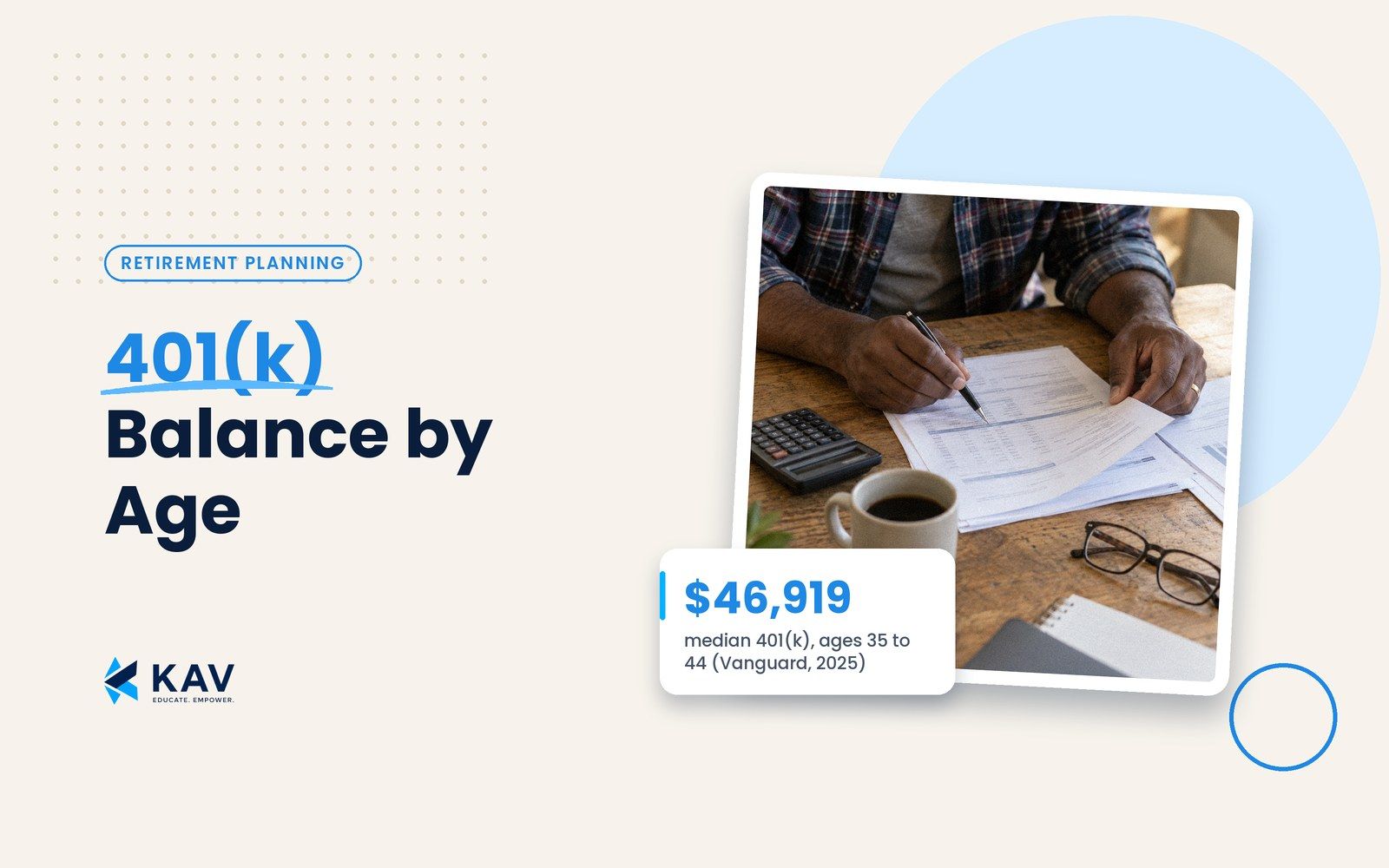
The short answer: In Vanguard's 2025 plan data, the average 401(k) balance for ages 35 to 44 was $120,742, but the median was $46,919. Vanguard says averages reflect savers at about the 75th percentile, so about 75% of participants had less. Compare yourself with the median for your age first, then with a goal based on your salary.
Key takeaways
- At every age, the median sits far below the average: $78,730 versus $214,991 for ages 45 to 54 (Vanguard, 2025).
- Balances count one employer's plan only, and 45.7% of families had no retirement account at all in 2022.
- Fidelity's guideline of 1x your salary by 30, 3x by 40 and 6x by 50 is a goal, not a typical balance.
- If you're behind, your savings rate is the lever: get the full match, raise your rate yearly, add catch-ups at 50.
What's the average 401(k) balance by age?
In 2025, the average 401(k) balance in Vanguard's plans rose with age, from $7,259 for savers under 25 to $330,186 at 65 and older, while the median stayed far lower (Vanguard, How America Saves 2026).
- Under 25: $7,259 average, $2,234 median
- 25 to 34: $50,261 average, $18,732 median
- 35 to 44: $120,742 average, $46,919 median
- 45 to 54: $214,991 average, $78,730 median
- 55 to 64: $305,006 average, $107,269 median
- 65 and older: $330,186 average, $103,202 median
Fidelity's numbers point the same way. Its average 401(k) balance was $155,800 as of June 30, 2026, across 25.8 million participants (Fidelity, Q2 2026 Retirement Analysis).
Why most savers sit below the average
A few very large accounts pull the average up, so it describes a saver who's well ahead, not a typical one. Vanguard puts it plainly: averages reflect participants "at about the 75th percentile," and about 75% of participants had less.
- The median is the middle. "The median balance represents the typical participant," Vanguard says. Half have more, half have less.
- Small balances are common. One in four Vanguard participants had less than $10,000, while 35% had more than $100,000.
- It's one employer's plan. Vanguard's balances measure what people "accumulated for retirement with a given employer." Old 401(k)s, rollover IRAs (individual retirement accounts) and a spouse's accounts aren't in them, which makes them "only a partial measure of retirement preparedness."
- Many families have no account at all. In the Federal Reserve's 2022 Survey of Consumer Finances, 54.3% of families held any retirement account, so 45.7% had none.
So if your balance is under the average for your age, you're in the majority. The better question is if you're on track for your own goal.
How much should you have in your 401(k) at 30, 40 and 50?
A widely used benchmark is Fidelity's: "Aim to save at least 1x your salary by 30, 3x by 40, 6x by 50, 8x by 60, and 10x by 67" (Fidelity). That guideline assumes you save 15% of your pay every year, employer match included, starting at 25, and retire at 67. It's a target for someone who started early, not a picture of where most people are today.
Example: two yardsticks, one saver
Take Marcus, 45, a project manager in Charlotte, North Carolina. He earns $80,000 and has $95,000 in his 401(k). He's an example, not a client.
- Against the median: his $95,000 beats the $78,730 median for ages 45 to 54.
- Against Fidelity's guideline: 3x his salary is $240,000, and 6x by 50 would be $480,000.
Marcus is ahead of the typical saver and well short of the goal. Both are true, and the goal is the one to plan around.
What to do if you're behind
The fix is usually your savings rate, the part you control. Market returns and your age aren't.
- Get the full employer match. Look up your plan's match formula in your benefits portal. If you're contributing less than it takes to get the whole match, you're leaving part of your pay on the table.
- Raise your rate a little every year. Savers tend to put in more as they age: in 2025, Vanguard's average deferral rate was 7.2% of pay for ages 35 to 44 and 9.3% for ages 55 to 64. Fidelity's benchmark is 15% including the match, and its 401(k) savers averaged a 14.4% total savings rate in mid-2026.
- Use catch-up contributions at 50. For 2026, the Internal Revenue Service (IRS) lets savers 50 and older add $8,000 on top of the $24,500 limit, or $11,250 at ages 60 to 63. Our guide to 401(k) catch-up contributions in 2026 covers who qualifies.
- Keep track of old plans. A 401(k) from a past job still counts toward your total. Before you cash one out, ask the plan or a tax professional what it would cost you.
For the bigger picture, our guide to how much you need to retire at 60 turns your spending into a target number.
Where to start this week
- Log in to every account you have (your current 401(k), old ones, any IRA) and add up the total.
- Compare that total with the median for your age, then with Fidelity's multiple of your salary.
- Check your contribution rate against your plan's match.
- Run your numbers through KAV's free retirement calculator.
If you'd like help turning this into a plan, KAV Solutions offers a complimentary Financial Needs Analysis. A licensed insurance professional walks through your retirement goals, and what would protect them if your income stopped, with you. The analysis is free and you never pay KAV a fee. If you choose to buy a policy, the insurer pays the professional a commission. For investment choices inside your 401(k), talk with your plan's resources or a securities-registered professional.
Frequently asked questions
Do women have less in their 401(k)s than men?
Yes, on average. In Vanguard's 2025 data, men had an average balance of $194,597 and women $146,476, with medians of $52,309 and $42,139. Vanguard says women in its sample tended to earn less, but "women tended to save more than men at each respective income level." Our guide to retirement planning for women covers the rest of the gap.
Do these averages include IRAs and old 401(k)s?
No. Vanguard's figures cover the plan at one employer. For a household view, the Federal Reserve's 2022 survey counted IRAs and employer accounts from current and past jobs together, and the median for families who had any was $86,900.
How much can I put in my 401(k) in 2026?
The limit is $24,500 for 2026, according to the IRS. If you're 50 or older, you can add $8,000 more, for $32,500 in all. At ages 60 to 63, the catch-up is $11,250 instead, for $35,750.
KAV Solutions is a women-led team of licensed insurance professionals based in Pennsylvania. This article is general education, not individualized financial, tax, or legal advice. Balances come from Vanguard's 2025 plan data and Fidelity's mid-2026 analysis; your own plan's results will differ, and past returns don't promise future ones.