You are 50 or older, there is finally some room in the budget, and you have heard you can save extra for retirement. Then a coworker says catch-ups "have to be Roth now," and you are not sure that applies to you.
Catch-up contributions are the extra amounts people 50 and older can add to a 401(k), 403(b), governmental 457(b) or individual retirement account (IRA) above the normal yearly limit. Here are the catch-up contributions for 2026, and the one rule that changed.
The short answer: In 2026, workers 50 and older can add up to $8,000 to a 401(k), 403(b) or governmental 457(b) on top of the $24,500 limit, or $11,250 at ages 60 to 63, according to the Internal Revenue Service (IRS). The IRA catch-up is $1,100. If your 2025 Social Security wages from your employer topped $150,000, the workplace catch-up must go in as Roth.
Key takeaways
- Your age on December 31 sets your limit: $32,500 in total at 50 to 59, $35,750 at 60 to 63, and $32,500 again the year you turn 64.
- The Roth rule looks only at last year's Box 3 wages from the employer that runs your plan, not household income or filing status.
- At ages 60 to 63, maxing out a 401(k) takes $1,375 a paycheck if you are paid every two weeks.
- Your plan has to allow catch-ups, and in Vanguard plans women used them less often than men in 2025: 15% versus 18%.
- Canada has no age-based catch-up; unused Registered Retirement Savings Plan (RRSP) room carries forward instead.
How much can you catch up in 2026?
Your limit depends on your plan type and the age you reach by December 31, 2026. The IRS puts it plainly: "Individuals who are age 50 or over at the end of the calendar year can make annual catch-up contributions" (IRS). Turn 50 in November and you can start in January.
The 2026 limits, from the IRS announcement:
- 401(k), 403(b), governmental 457(b) and the federal Thrift Savings Plan, ages 50 to 59: $8,000 on top of the regular $24,500, for $32,500 in total.
- The same plans, ages 60 to 63: $11,250 instead, for $35,750 in total. This is often called the super catch-up.
- Age 64 and older: back to $8,000. The tax code gives the higher amount only to someone who "would attain age 60 but would not attain age 64" by year-end (26 U.S.C. 414(v)). To use all four years, start the year you turn 60.
- Traditional and Roth IRAs: $1,100 on top of $7,500, for $8,600 in total.
- Savings Incentive Match Plan for Employees (SIMPLE) plans: generally $4,000, or $5,250 at ages 60 to 63.
Most plans need no special form. The IRS says deferrals "are not treated as catch-up contributions until they exceed the limit of $24,500 in 2026," so you usually just raise your contribution rate. Some plans want a separate catch-up election.
Do catch-up contributions have to be Roth in 2026?
Catch-up contributions have to be Roth only if you earned more than $150,000 in Social Security wages in 2025 from the employer that sponsors your plan. Those workers "must make catch-up contributions on a Roth basis," the IRS says (IRS). Everyone else still picks pre-tax or Roth, if the plan offers both.
Roth money goes in after tax, so the catch-up no longer lowers this year's taxable income. Our Roth IRA vs traditional IRA guide explains when paying the tax now tends to work out; the same test applies inside a 401(k).
What counts as wages for the $150,000 test
- Box 3 of your 2025 Form W-2. The final Treasury regulations use Social Security wages in Box 3, not Medicare wages in Box 5 (Federal Register).
- One employer at a time. The law counts wages "from the employer sponsoring the plan" (26 U.S.C. 414(v)). A spouse's pay, a second job and investment income do not count, and neither does your filing status.
- A new job resets the test. If you joined your employer in 2026, it paid you no 2025 wages, so the rule generally does not apply there this year.
If your plan has no Roth option
A plan without a Roth option cannot take catch-ups from workers over the $150,000 line. Vanguard reports the rule "has led nearly all plans to adopt Roth accounts" (How America Saves 2026). For 2026, plans may follow "a reasonable, good faith interpretation" of the law while the final rules take effect in 2027 (IRS), so the paperwork varies.
Example: a 61-year-old maxing out her 401(k)
Take an illustrative saver: 61 in 2026, earning $130,000, paid every two weeks, in a 401(k) with the higher catch-up and a Roth option. Her 2025 Box 3 wages were $128,000.
- Regular limit: $24,500
- Age 60 to 63 catch-up: $11,250
- 401(k) total: $35,750, which is $1,375 a paycheck over 26 paychecks, or 27.5% of her pay
- IRA with catch-up: $8,600, for $44,350 across both
- Roth rule: $128,000 is under $150,000, so she chooses pre-tax or Roth
Saving 27.5% of pay is out of reach for many families. Vanguard found that people earning under $100,000 "would need deferral rates higher than 20% of income" to catch up at all. The window is what counts: at 2026 levels, four years of the higher catch-up total $45,000, against $32,000 at the standard amount. That is $13,000 of extra room, gone the year she turns 64. To see whether it closes your gap, start with how much you need to retire at 60.
What can change your catch-up number
Your plan's rules
Catch-ups are allowed, not required: the IRS says they "may be permitted" by 401(k), 403(b) and governmental 457(b) plans. Nearly all Vanguard plans offer them, and its How America Saves 2026 found 91% had adopted the higher limit for ages 60 to 63 by the end of 2025. Ask human resources (HR) before you count on the extra $3,250.
Whether you have years to make up
In Vanguard plans, only 17% of eligible savers 50 and older made catch-up contributions in 2025, and women less often than men: 15% against 18%, according to Vanguard. If you stepped back from work to care for children or a parent, the catch-up years are one way to rebuild. Our guide to retirement planning for women covers the other gaps worth closing.
Canada: no catch-up, but unused RRSP room carries forward
RRSP room does not grow at 50. The Canada Revenue Agency (CRA) builds your limit from your "unused RRSP deduction room at the end of the preceding year" plus 18% of last year's earned income, up to the annual limit, minus any pension adjustment (CRA). The 2026 dollar limit is $33,810 (CRA limits).
That carry-forward does the job a catch-up does in the US: room you skipped in your 40s is still there in your 50s. Our guide to choosing between a Tax-Free Savings Account (TFSA) and an RRSP covers which to fill first.
What to do before your next paycheck
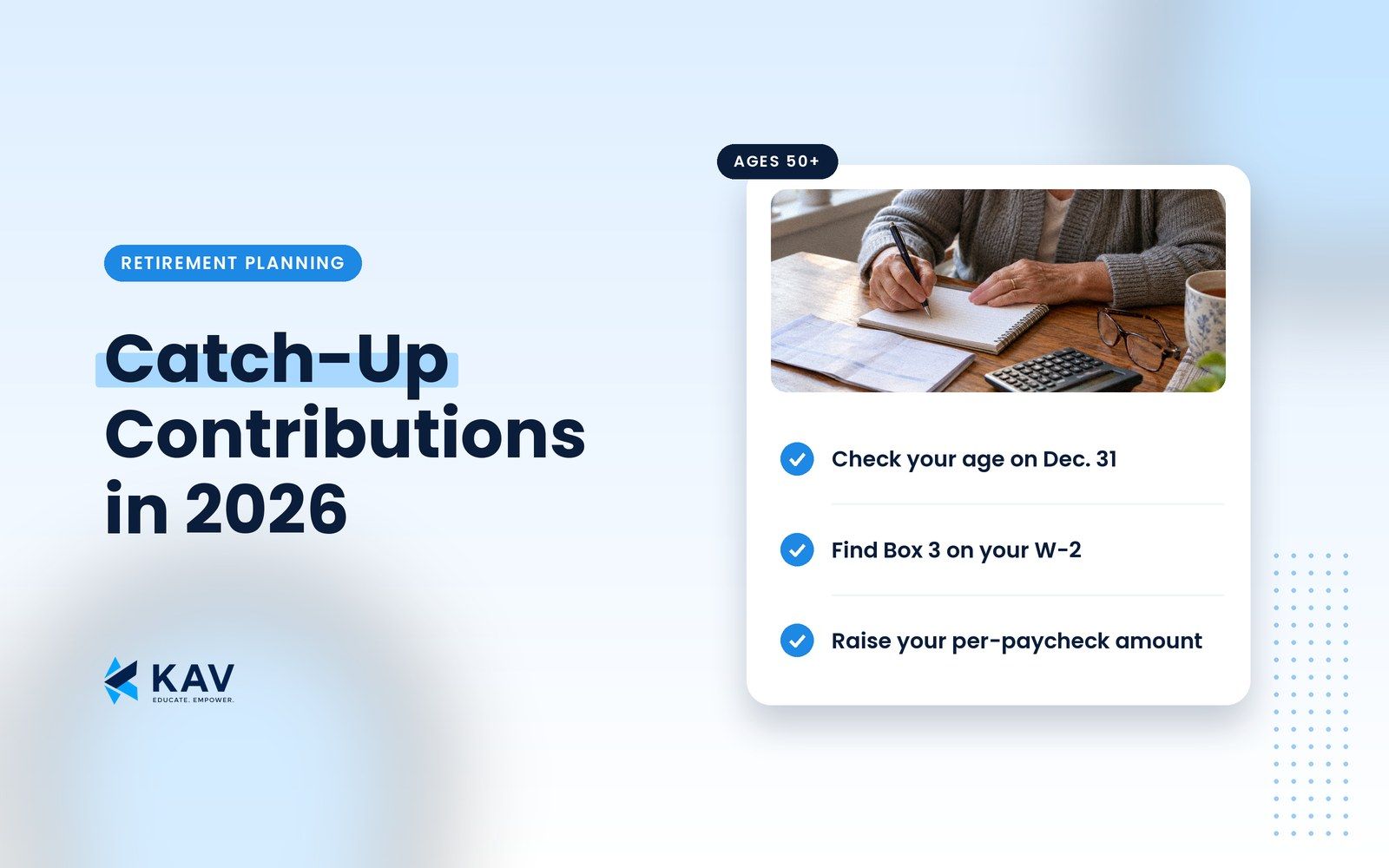
- Check your age on December 31, 2026. It decides whether your 401(k) limit is $32,500 or $35,750.
- Find Box 3 on your 2025 Form W-2. Over $150,000 from your current employer means your catch-up goes in as Roth.
- Ask HR three questions: are catch-ups allowed, is the age 60 to 63 amount offered, and is a separate election needed?
- Turn your goal into a per-paycheck amount. Divide it by the paychecks left this year and raise your rate to match.
- Add the IRA catch-up if you also save in an IRA: $8,600 in total for 2026.
If you would like help turning this into a plan, KAV Solutions offers a complimentary Financial Needs Analysis. A licensed insurance professional walks through your retirement goals, how much you can still set aside and your family's protection needs with you. The analysis is free and you never pay KAV a fee. If you choose to buy a policy, the insurer pays the professional a commission. For the pre-tax or Roth decision, bring your numbers to a tax professional.
Frequently asked questions
Are catch-up contributions going away in 2026?
No. The 401(k) catch-up rose to $8,000 for 2026, up from $7,500, and the IRA catch-up rose to $1,100. What changed is the tax treatment for higher earners: with 2025 Social Security wages over $150,000 from your employer, your workplace catch-up must be Roth.
Do catch-up contributions count toward the 401(k) limit?
No. Catch-ups sit on top of the $24,500 employee limit, and the tax code keeps them outside the separate cap on total employee and employer contributions, $72,000 for 2026 (IRS Notice 2025-67). An employer match does not use up your catch-up room.
Can I use the age 60 to 63 catch-up in an IRA?
No. The higher amount applies to workplace plans: 401(k), 403(b), governmental 457(b) and SIMPLE plans. For traditional and Roth IRAs the catch-up is $1,100 at every age from 50, for $8,600 in total in 2026, and the Roth requirement for higher earners does not apply.
Can self-employed people make catch-up contributions?
Yes, if the plan allows them; a one-person 401(k) uses the same $8,000 and $11,250 limits. The Roth rule is based on Social Security wages from the employer, so the final regulations exempt someone whose only income from the business is self-employment income, such as a partner.
KAV Solutions is a women-led team of licensed insurance professionals based in Pennsylvania. This article is general education, not individualized financial, tax, or legal advice. Plan features vary by employer, and the figures here are the 2026 limits.