Your bank shows a high-yield savings account and a money market account side by side. Your brokerage app has a "money market" button too. So you wonder: are they the same thing, and can a money market account lose money?
The high-yield savings account vs money market account choice is closer than the names suggest: both are insured deposits, backed by the Federal Deposit Insurance Corporation (FDIC) at banks. The money market fund at your brokerage is the different one.
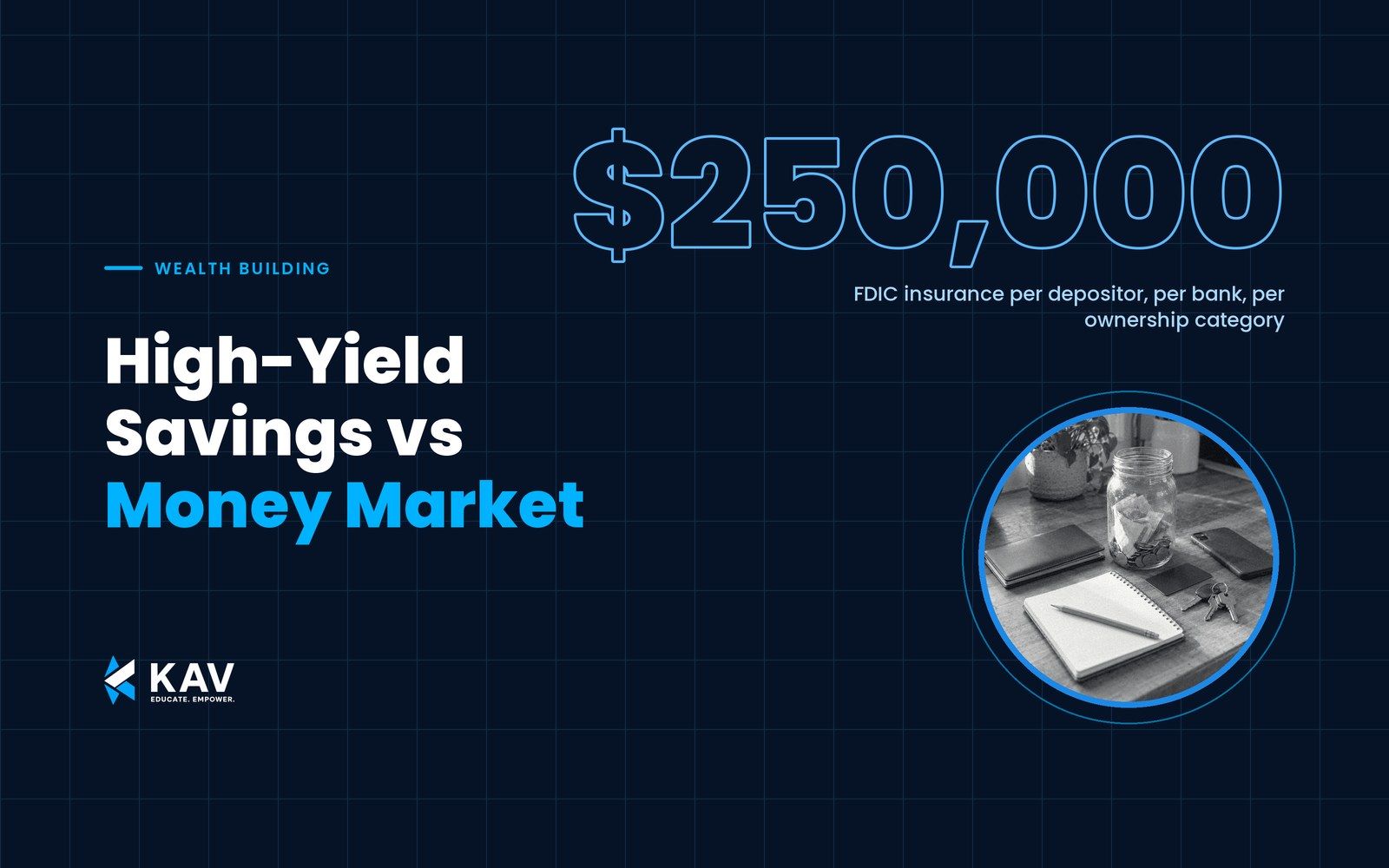
The short answer: A high-yield savings account and a money market account are both insured deposits: the FDIC or the National Credit Union Administration (NCUA) covers up to $250,000 per depositor, per institution, for each ownership category (FDIC, NCUA). The money market account may add checks, a debit card and a minimum balance. A money market fund is an investment, not FDIC-insured; a retail fund aims to hold $1 a share.
Key takeaways
- Savings and money market accounts carry the same insurance. The money market account trades a minimum balance for checks or a debit card.
- A money market fund can lose value. It aims for $1 a share, and the last time one fell below $1 was 2008.
- As of the FDIC's October 19, 2026 national rates, the averages were 0.38% for savings and 0.63% for money market accounts, so compare the rate, not the label.
- Match each dollar to when you need it: emergency cash in an insured account, a known bill a year out in a certificate of deposit (CD) or fund.
- In Canada, deposit insurance covers $100,000 per category, and money market exchange-traded funds (ETFs) are not covered.
High-yield savings vs money market account vs money market fund
A high-yield savings account is a savings account marketed with a rate above the national average. "High-yield" is a marketing label, not a regulated term, so compare its APY with the FDIC national average. The other two share the words "money market" and very little else.
High-yield savings account
- Where it lives. A bank or credit union.
- Insurance. Up to $250,000 per depositor, per bank, for each ownership category (FDIC), or the same through the NCUA at a credit union.
- Access. Transfers to your checking account, usually without checks or a debit card.
Money market account
- Where it lives. Also a bank or credit union. The Consumer Financial Protection Bureau (CFPB) calls it "a type of account offered by banks and credit unions" (CFPB).
- Insurance. The same FDIC or NCUA coverage, up to $250,000.
- Access. Often checks or a debit card, though these accounts "usually limit the number of transactions you can make" that way. ATM and in-person withdrawals are usually unlimited.
- The catch. It "might require a minimum amount to be deposited."
Money market fund
- Where it lives. A brokerage or fund company. The Financial Industry Regulatory Authority (FINRA) describes it as a type of mutual fund that holds assets "generally easy to convert to cash."
- Insurance. None from the FDIC. Mutual funds are on the FDIC's not-covered list, even when a bank sells them (FDIC).
- Price. A retail money market fund aims to keep each share at $1 (some institutional funds have a floating price), and its payouts are dividends, not interest.
Can a money market account lose money?
Money in a money market account at an insured bank is protected up to the $250,000 limit. In the FDIC's own words, "Since the FDIC was founded in 1933, no depositor has lost a penny of FDIC-insured funds."
A money market fund can lose value, because it is an investment. FINRA says a fund has occasionally "broken the buck," meaning its value fell below $1 a share, and the last time was during the 2008 financial crisis. It is rare, but nothing insures you against it.
If the brokerage is a SIPC member, the Securities Investor Protection Corporation (SIPC) protects the cash and securities in your account up to $500,000, including a $250,000 limit for cash. That protects you if the brokerage fails, not if the fund falls: "SIPC does not protect against the decline in value of your securities" (SIPC).
Before you move your emergency fund, check whether the statement says "account" or "fund."
An example: $25,000 of family cash in three places
An illustrative family with $25,000 in cash could split it by when they will need it. Here is what each piece would earn at the FDIC's national average rates published October 19, 2026:
- $4,000 in checking for bills and a cushion. Interest checking averaged 0.07%.
- $15,000 emergency fund in a high-yield savings or money market account. At the 0.63% money market average it earns about $95 a year; at the 0.38% savings average, about $57.
- $6,000 for a roof next summer in a 12-month CD at the 1.76% average: about $106, if it stays put until maturity.
The averages include big branch banks that pay very little; accounts marketed as high-yield can pay well above them. On $15,000, each extra percentage point is about $150 a year before tax, which is why the rate on the specific account matters more than its name.
Which fits your money: start with when you need it
Choose by the date you will need the money first, then by the rate. For how big the first layer should be, see how much should be in an emergency fund.
Choose a high-yield savings account if
- You are building an emergency fund and want it out of sight of your debit card.
- You want no minimum balance and are happy moving money by transfer.
Choose a money market account if
- You want the same insurance plus a few checks or a debit card for large, irregular bills.
- You can keep the minimum balance, and its rate beats the savings account you would otherwise use.
When a CD or a money market fund may fit
- You know the date: a tax bill, a car, a roof. A CD fixes the rate, but the Internal Revenue Service (IRS) notes that if you withdraw before maturity, "you may have to pay a penalty."
- Some people use a money market fund for cash already sitting in a brokerage account, knowing that a fund is an investment and is not FDIC-insured.
In Canada: savings accounts, GICs and money market ETFs
The Canada Deposit Insurance Corporation (CDIC) covers eligible deposits up to $100,000 per category, per member institution, including principal and interest (CDIC).
- Covered. High-interest savings accounts (HISAs) held at a CDIC member in an insured category can qualify, and so do guaranteed investment certificates (GICs), the Canadian version of a CD.
- Not covered. CDIC states that "HISA Exchange Traded Funds (ETF), also called money market ETFs, and HISA mutual funds, are not protected by CDIC" (CDIC). If an app shows your "money market" holding as units of a fund, it is not a deposit.
- Separate room. Deposits inside a Tax-Free Savings Account (TFSA) are their own category with their own $100,000 (CDIC). See how a TFSA compares with a Registered Retirement Savings Plan (RRSP).
Where to start this week
- Open your latest statement and find the exact product name: savings account, money market account, or money market fund.
- Confirm the bank is FDIC-insured or the credit union NCUA-insured, and that each ownership category at that institution stays under $250,000.
- Compare the annual percentage yield (APY) on your account with two others, and note any minimum balance.
- Write down when you will need each chunk of cash, then match it to an account. If you are not sure what a month costs you, start with how to make a budget.
- Set up an automatic transfer on payday so the emergency layer grows without a decision.
If you would like help turning this into a plan, KAV Solutions offers a complimentary Financial Need Analysis. A licensed insurance professional walks through your emergency fund target, your short-term goals and the protection your family would need if a paycheck stopped. The analysis is free and you never pay KAV a fee. If you choose to buy a policy, the insurer pays the professional a commission.
Frequently asked questions
Is a money market fund or a high-yield savings account better for taxes?
Interest from a savings or money market account is taxable income. The IRS says money market fund payouts are generally reported as dividends instead. A fund that holds only U.S. Treasury debt may lower your state income tax, because federal law exempts Treasury obligations from state tax. How much passes through depends on your state.
Does a joint account get more FDIC coverage?
Yes. The FDIC insures joint accounts at "$250,000 per co-owner," so a couple's joint savings account at one bank is covered up to $500,000 (FDIC). Joint accounts are their own ownership category, separate from each person's single accounts at the same bank.
Can I only make six withdrawals a month from a savings account?
Not under federal rules anymore. In April 2020 the Federal Reserve deleted the six-per-month limit on convenient transfers from savings deposits. Banks may still set their own limits, especially on money market accounts, so check your account agreement before you count on unlimited transfers.
KAV Solutions is a women-led team of licensed insurance professionals based in Pennsylvania. This article is general education, not individualized financial, tax, or legal advice. Rates, minimum balances and account terms vary by bank, credit union and fund, and deposit insurance rules differ between the USA and Canada.