It's open enrollment, and somewhere in the benefits portal there's a box for a dependent care flexible spending account (FSA). You're already paying for daycare or after-school care, and it isn't cheap. Care.com's 2026 Cost of Care Report puts the average child care center at $332 a week, and the average parent says they spend 20% of household income on it.
So should you check the box, and how much should you put in?
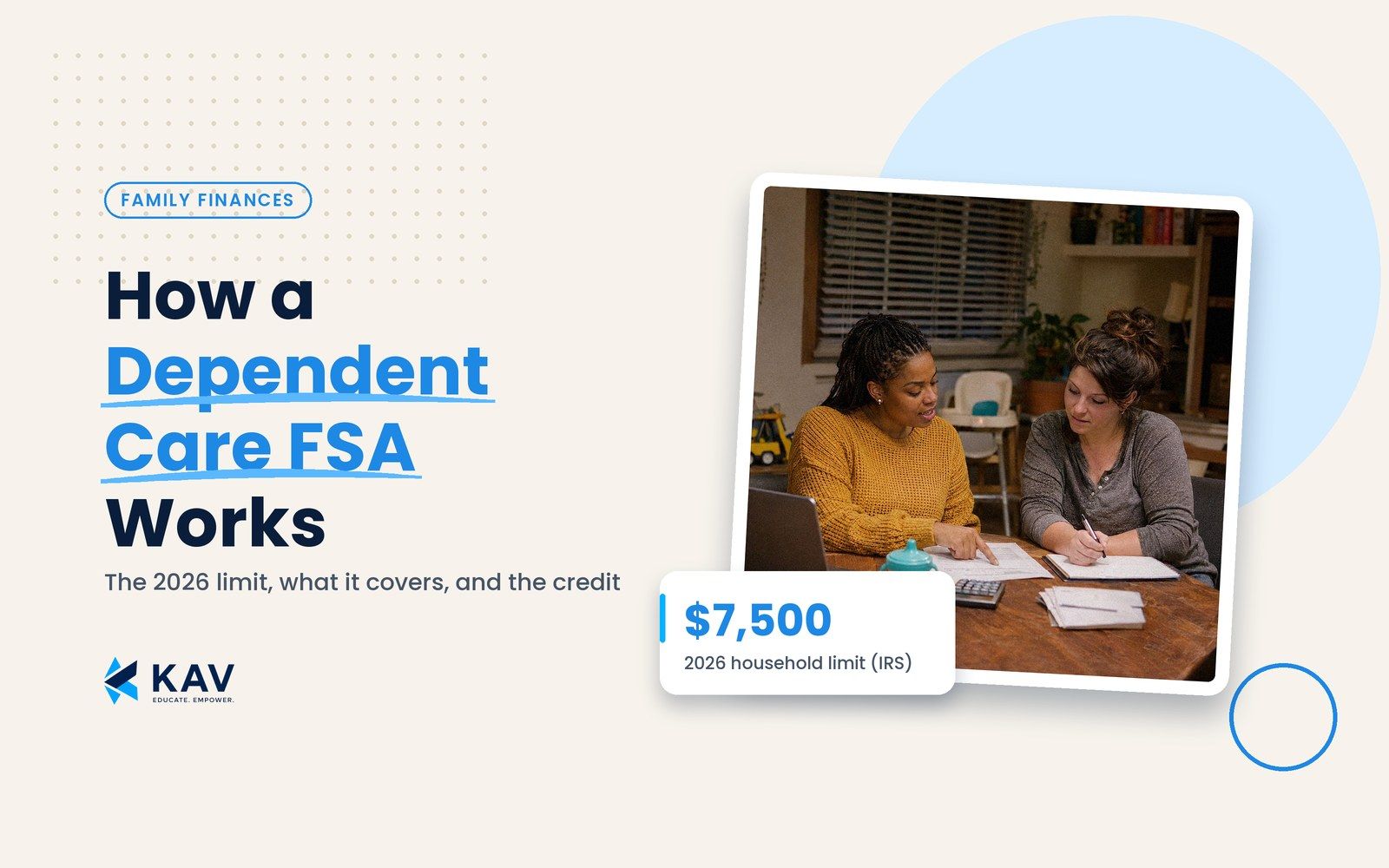
The short answer: A dependent care FSA pays for work-related care of a child under 13, or of a spouse or dependent who can't care for themselves. The money skips federal income tax and Social Security and Medicare taxes. For 2026 the limit is $7,500 per household ($3,750 if married filing separately), up from $5,000, according to Internal Revenue Service (IRS) Publication 15-B.
Key takeaways
- The $7,500 limit for 2026 is per household, not per child, and the lower-earning spouse's pay can cap it.
- It covers daycare, preschool, after-school care and summer day camp, but not overnight camp or kindergarten tuition.
- You pick an amount at open enrollment, it's paid back as you file claims, and money left after the deadline is lost.
- In our example, a two-income family at $160,000 saves about $2,224 with the FSA versus $1,920 with the 2026 tax credit.
- Elect less, or skip it, if a parent stays home, your care costs are uncertain or your plan limits high earners.
What is a dependent care FSA?
A dependent care FSA is an employer benefit account that pays you back, with pre-tax pay, for the care you need so you (and your spouse) can work. The care must be for a child under 13, or a spouse or dependent who's "physically or mentally incapable of caring for himself or herself" and lives with you more than half the year (26 U.S.C. § 21).
The 2026 rules:
- The limit is $7,500. The One Big Beautiful Bill Act, signed July 4, 2025, raised it from $5,000 for tax years beginning after December 31, 2025 (26 U.S.C. § 129). Your employer's plan can set a lower cap.
- It's per household, not per child. Two kids or three, the cap stays at $7,500. On a joint return it covers both spouses, since Form 2441 counts benefits that you "or your spouse if filing jointly" received (IRS).
- It skips payroll tax too. IRS Publication 15-B exempts it from income tax withholding and from Social Security and Medicare taxes, a 7.65% employee share (6.2% plus 1.45%, per IRS Tax Topic 751). State treatment depends on your state.
- The lower earner's pay caps it. The exclusion "can't be more than the smaller of the earned income of either the employee or employee's spouse," Publication 15-B says. If one of you earns $5,000, that's your ceiling.
- A student or disabled spouse counts as earning $250 a month with one qualifying person in care, or $500 a month with two or more, under section 21.
Single parents use their own pay as the cap; our guide to financial planning for single moms covers the rest of a one-income budget.
What a dependent care FSA pays for, and what it doesn't
A dependent care FSA pays for care that lets you work, not for school. The rules come from IRS Publication 503, the same ones used for the child and dependent care credit.
Usually covered
- Daycare, at a center or in a provider's home.
- Preschool. Nursery school or a similar program below kindergarten counts as care.
- Before- and after-school care, even for kindergartners and older kids.
- Summer day camp. "The cost of sending your child to a day camp may be a work-related expense, even if the camp specializes in a particular activity, such as computers or soccer."
- A nanny or babysitter who watches your child while you work.
- A grandparent or other relative, unless it's your spouse, your child's other parent, someone you can claim as a dependent, or your own child under 19.
Not covered
- Overnight camp, which "isn't considered a work-related expense."
- Tuition for kindergarten and up, public or private. "Expenses to attend kindergarten or a higher grade aren't expenses for care."
- Summer school, tutoring, and care that isn't work-related, like a sitter for a Saturday night out.
Before you pay anyone, get the provider's name, address and taxpayer identification number. "You must identify the care provider on your tax return," Publication 503 says.
How a dependent care FSA works, step by step
You pick a yearly amount, it comes out of each paycheck, and you're paid back as you file claims:
- Choose your amount at open enrollment. It usually sticks for the plan year. Your plan may allow a change after marriage, divorce, a birth or adoption, a job change, or a price change by a provider who isn't a relative (Treasury regulation 1.125-4).
- Pay the provider and keep the receipts.
- Send in a claim with the provider's details and the dates of care.
- Get paid back from what's in the account. Unlike a health FSA, you may not get the year's full amount on day one: IRS proposed regulations say "the uniform coverage rule does not apply to FSAs for dependent care assistance" (Federal Register, 2007). A big January bill may come back over a few paychecks.
- Use it by the deadline. Unused money is forfeited after the plan year and any grace period. A grace period can run to the 15th day of the third month after the plan year ends, or March 15 for a calendar-year plan (IRS Notice 2005-42). The carryover in Publication 15-B is a health FSA feature.
- Report it at tax time. Your W-2 shows the total in box 10, and you list your provider in Part III of Form 2441.
FSA or child care tax credit? A 2026 example
For a two-income family in the 22% federal bracket, a full $7,500 election can save more than the child and dependent care credit, and you can't use both on the same dollars.
What changed for the credit in 2026
"Beginning with tax year 2026, the maximum credit rate increases from 35% to 50% of qualifying expenses," the IRS says. It still applies to up to $3,000 of care for one child or $6,000 for two or more. Under section 21, the 50% rate drops 1 point for every $2,000 of adjusted gross income (AGI) over $15,000, down to 35%. Above $150,000 of joint AGI ($75,000 for other filers), it drops another point per $4,000 ($2,000), down to 20%.
That $6,000 is "reduced by the aggregate amount excludable from gross income under section 129," meaning your FSA money. So a full $7,500 election now wipes out the credit entirely, however many kids you have. Under the old $5,000 cap, a family with two or more kids still had $1,000 of care left for the credit.
The example: Keisha and Lauren
Keisha, 33, is a nurse, and her wife, Lauren, 35, is an office manager in Harrisburg, Pennsylvania. They're an example, not KAV clients.
- Their situation: joint AGI of $160,000 ($80,000 each), kids ages 3 and 7, and about $16,000 a year of daycare, after-school care and day camp.
- Their bracket: after the 2026 joint standard deduction of $32,200, taxable income is $127,800, inside the 22% bracket that runs from $100,800 to $211,400 for joint filers (IRS).
- The FSA route: $7,500 × 22% saves $1,650 of income tax, and $7,500 × 7.65% saves $574 of payroll tax, for about $2,224. The credit drops to $0.
- The credit-only route: their AGI is $10,000 over $150,000, or 2.5 steps of $4,000, which rounds up to 3 points. 32% × $6,000 = $1,920.
- The difference: about $304 in favor of the FSA, by KAV's math, before any state tax effect.
The FSA wins here because it also skips payroll tax, and their income trims the credit to 32%.
At lower incomes the math can flip. A couple with two kids and $70,000 of AGI, in the 12% bracket, would save about $1,474 with the FSA but could get up to $2,100 from the credit. The credit only reduces income tax you owe, though. If the tax left on the Form 2441 worksheet is zero or less, the instructions say "stop; you can't take the credit." Run both in tax software or with a tax professional.
When a dependent care FSA isn't worth it
A dependent care FSA is a poor fit when one spouse has no earned income, when you can't predict your care costs, or when your plan limits high earners.
- One parent stays home. With no earned income and no student or disability exception, the cap is $0. An individual retirement account (IRA) funded from one paycheck, called a spousal IRA, is a tax break built for that household.
- Your care plans could change. Elect only what you're sure to spend. At $332 a week, full-time center care uses up $7,500 in about 23 weeks; a maybe-summer-camp is shakier ground.
- You're a highly compensated employee. For 2026 that's more than $160,000 of pay in 2025, or being a 5% owner of the business. Your benefit is tax-free only if the plan doesn't favor highly compensated employees, and one of section 129's tests requires everyone else's average benefit to be at least 55% of theirs. Ask your benefits office whether your election could be cut back.
What to do before open enrollment closes
- Add up next year's care: daycare, after-school care and summer day camp weeks, without overnight camp or tuition.
- Check both paychecks. The lower earner's pay caps the FSA, and a spouse who'll be home most of the year changes the answer.
- Elect what you're sure to spend, up to $7,500 for the household, combined across both employers if you each have one.
- Ask your provider for their taxpayer identification number now, so Form 2441 isn't a scramble in April.
- Fit the deduction into your budget, since it leaves every paycheck before reimbursements come back. See how to make a budget for beginners, and the financial checklist for new parents for the other benefit changes a new baby brings.
If you would like help turning this into a plan, KAV Solutions offers a complimentary Financial Needs Analysis. A licensed insurance professional walks through your family's budget, goals and how well your income is protected if a paycheck stops. The analysis is free and you never pay KAV a fee. If you choose to buy a policy, the insurer pays the professional a commission. For tax decisions, bring the numbers to a tax professional.
Frequently asked questions
Does the dependent care FSA limit reset if I change jobs?
No. The $7,500 limit applies to care during the tax year, not to each employer's plan, so an old job and a new job count together. Tell the new employer what you've already put in. Some plans also let you claim care after you leave, an option the 2007 IRS proposed rules allow.
Can divorced parents both use a dependent care FSA for the same child?
Generally only the custodial parent can, meaning the parent the child lived with for more nights during the year. Publication 503 says the other parent "can't treat the child as a qualifying person even if that parent is entitled to claim the child as a dependent."
Is a dependent care FSA the same as a health FSA?
No. They're separate accounts with separate limits. A health FSA pays medical costs and is capped at $3,400 for 2026, with an optional carryover of up to $680. A dependent care FSA can't pay doctor bills, and a health FSA can't pay for daycare.
Can I use a dependent care FSA for my aging parent's adult day care?
Yes, if your parent can't care for themselves, lives with you more than half the year, qualifies as your dependent under the care rules, and the care lets you work. Our guide to taking care of aging parents financially covers the other costs that come with it.
KAV Solutions is a women-led team of licensed insurance professionals based in Pennsylvania. This article is general education, not individualized financial, tax, or legal advice. Plan rules, deadlines and employer limits vary, so check your plan's summary for the year you enroll.