New parents get a hospital bag list and a car-seat check. Nobody hands you the money list, so it gets done in a rush or not at all. If you are reading this at 2 a.m. wondering whether you are already behind, you probably are not. Most of what matters fits into a few deadlines.
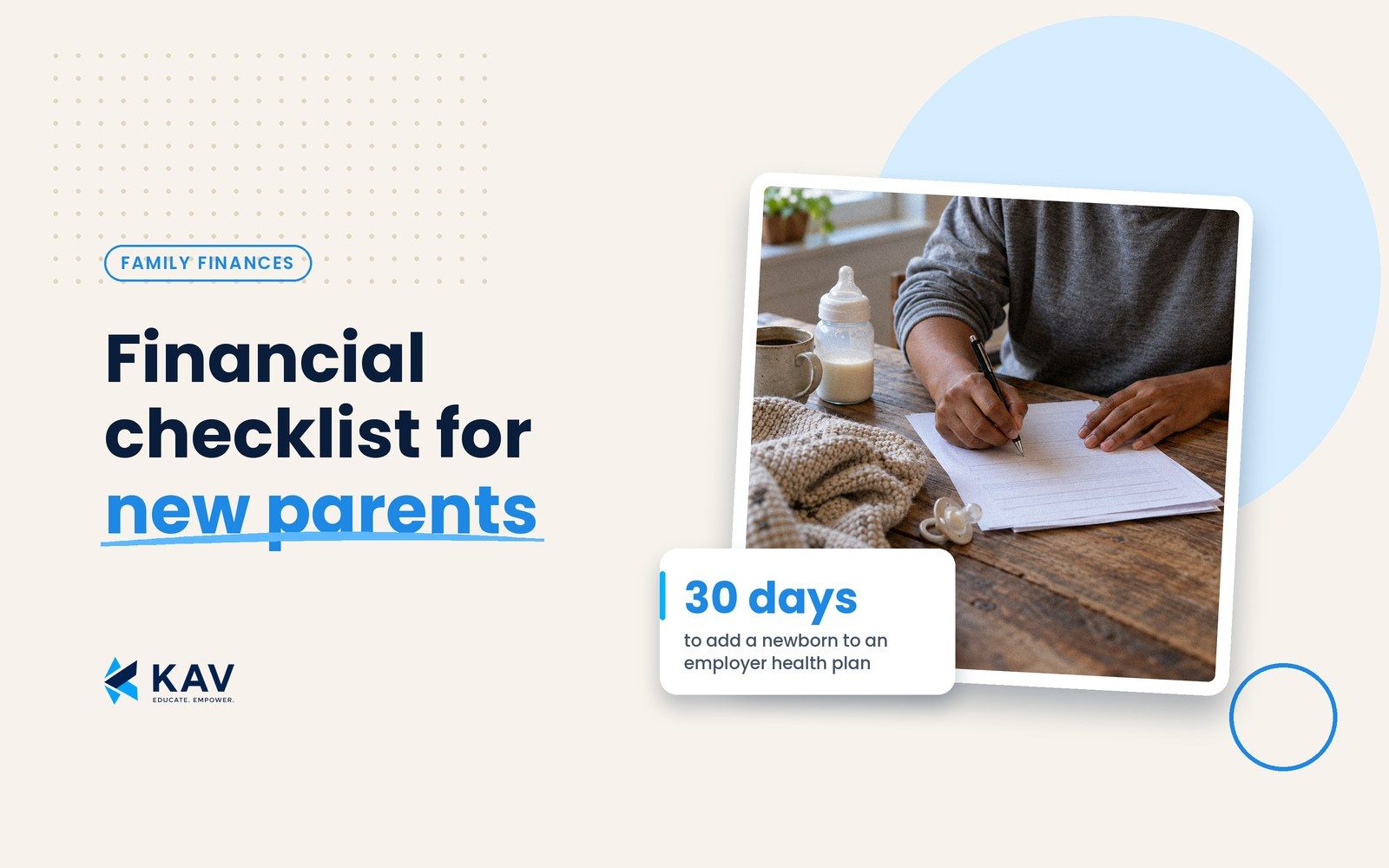
This financial checklist for new parents is sorted by when each task is due, starting with the two that have hard cut-offs.
The short answer: In the first 30 days, add your baby to your health plan (employer plans must give you at least 30 days, HealthCare.gov plans 60) and get a Social Security number at the hospital. In the first three months, buy or raise life insurance, fix your beneficiaries and name a guardian in a will. Within the year, budget for child care and claim the 2026 tax breaks.
Key takeaways
- Two deadlines come first: at least 30 days to add a newborn to an employer health plan, 60 days on HealthCare.gov.
- Life insurance, beneficiary forms and a will that names a guardian protect the income your baby now depends on.
- Infant daycare posted on Care.com averaged $332 a week in 2025, so the child care budget and the tax breaks belong in year one.
- In Canada, apply for the Canada child benefit (CCB) and open a Registered Education Savings Plan (RESP) to collect the 20% federal grant.
- The costly mistakes are missing the 30-day window and naming the baby as a beneficiary directly.
In the first 30 days: coverage and paperwork
Two of these tasks have legal deadlines, so start here.
- Add your baby to your health insurance. A birth opens a special enrollment period. The Code of Federal Regulations (CFR) requires employer plans to give you "at least 30 days" after the birth to request coverage (29 CFR 2590.701-6). On a HealthCare.gov plan, coverage can start on the day of the birth "even if you enroll in the plan up to 60 days afterward" (HealthCare.gov).
- Say yes to a Social Security number at the hospital. The Social Security Administration (SSA) says the easiest way to get one is to apply "when you provide information for your baby's birth certificate in the hospital" (SSA). You need it to claim your baby on your tax return.
- Update your workplace benefits. A birth counts as a change in status, so cafeteria plans may let you change your elections mid-year (26 CFR 1.125-4). This is the moment to join a dependent care flexible spending account (FSA). For 2026 the dependent care FSA limit rose from $5,000 to $7,500 ($3,750 if married filing separately), according to IRS Publication 15-B, so check what your plan allows. File a new Form W-4 too: the IRS says to consider one "when your personal or financial situation changes" (IRS).
- Confirm your leave. The Family and Medical Leave Act (FMLA) gives eligible employees "up to 12 workweeks" of unpaid, job-protected leave for a birth, and your group health coverage continues (Department of Labor). Paid leave depends on your employer and your state.
In the first three months: protect the income your baby depends on
Your baby now depends on your paychecks and on the unpaid work done at home, and this part of the list keeps that support in place if a parent dies.
- Buy or raise life insurance. Many young families start by pricing term insurance that lasts until the youngest child is independent. To size it, our guide to how much life insurance you need walks through the count, including Social Security survivors benefits. A stay-at-home parent needs coverage too, because their work would have to be paid for. Our guide to life insurance for stay-at-home moms shows how to size it.
- Fix your beneficiary forms. Check who is named on every life insurance policy and retirement account. Do not name the baby directly: our guide explains what happens when a minor is a life insurance beneficiary and the better way to set it up.
- Write a will that names a guardian. A will is where parents usually nominate who would raise their child. Choosing a guardian also means deciding who manages the money. An estate-planning attorney in your state or province should draft or review it.
In the first year: budget, savings and tax breaks
Once the deadlines are handled, the rest of the first year is about cash flow.
Build the child care line first
Care.com's 2026 Cost of Care Report puts the average posted daycare rate for one infant at $332 a week in 2025, and found that "the average parent is spending 20% or more of annual income on child care" (Care.com). Put your provider's real quote into a simple budget before any other goal, and keep an emergency fund that covers the new costs.
Claim the Child Tax Credit
The credit is worth up to $2,200 per qualifying child under 17, with up to $1,700 of it refundable. You (or your spouse, if you file jointly) and each qualifying child need a Social Security number that is valid for employment and issued by the due date of your return (IRS). Add the dependent care FSA from your benefits update and the first year carries two tax breaks.
Decide where the baby's savings go
A baby born from 2025 through 2028 who is a U.S. citizen with a valid Social Security number qualifies for a $1,000 federal seed contribution to a Trump account. Parents request it on IRS Form 4547, and contributions have been allowed since July 4, 2026 (IRS). For college money, a 529 plan is the other main option; our Trump account vs 529 plan comparison shows which fits.
In Canada: the benefit and the grant to claim
- Canada child benefit. For July 2026 to June 2027 the maximum is $8,157 a year for each child under 6, paid in full when adjusted family net income is below $38,237, according to the Canada Revenue Agency (CRA).
- RESP and the Canada Education Savings Grant (CESG). The government adds 20% of what you contribute, up to $500 a year per child ($1,000 if there is unused room from earlier years) and $7,200 over the child's lifetime (CRA).
Traps new parents fall into
- Missing the enrollment window. The window is at least 30 days on employer plans and 60 days on HealthCare.gov, and missing it can leave a newborn uninsured.
- Naming the baby as a beneficiary. It feels loving, and it hands the money to a child who cannot legally manage it.
- Saving for college before the basics. A 529 can wait a few months. The insurance, the will and the emergency fund cannot.
- Upgrading the car or the house in a hurry. Big purchases are easier to judge once you know what child care will cost.
Where to start this week
- Contact your benefits team or log in to your benefits portal and add the baby to your health plan.
- If you did not apply for the Social Security number at the hospital, start the SSA's online application and finish it at a local office.
- List every policy and account that has a beneficiary, and update each one.
- Book a will appointment, and ask the guardian you want before you name them.
If you would like help turning this into a plan, KAV Solutions offers a complimentary Financial Need Analysis. A licensed insurance professional walks through your coverage, your child care budget and your savings goals with you. The analysis is free and you never pay KAV a fee. If you choose to buy a policy, the insurer pays the professional a commission. KAV's insurance professionals are not attorneys, so the will itself belongs with an estate-planning attorney.
Frequently asked questions
Do I have to get my baby a Social Security number?
No. The SSA says getting one "is voluntary, but may be necessary to obtain important services." In practice you need it to claim your baby as a dependent, to claim the Child Tax Credit and the $1,000 Trump account seed, and often to open a bank account or arrange medical coverage for the child.
How much life insurance do new parents need?
Start from what your family would need if one income stopped: the years until your youngest is independent, the mortgage and other debts, child care, and any college goal, minus savings and coverage you already have. That is the calculation a Financial Need Analysis walks through.
Do we need a will if we don't own much?
Yes, once you have a child. A will is not only about money: it is usually where parents nominate a guardian for a minor and say who should manage what the child inherits, including life insurance proceeds. Without one, those decisions are left to others.
When does the Canada child benefit start?
Payments start after you apply and the CRA confirms eligibility. Its own example says that for a child born in March 2027, "you may receive your first CCB payment in April 2027 or in the month following your eligibility." Apply as soon as the birth is registered.
KAV Solutions is a women-led team of licensed insurance professionals based in Pennsylvania. This article is general education, not individualized financial, tax, or legal advice. Enrollment windows, benefit rules and limits vary by employer, state and province; the figures here are for 2026.