You pay the minimum on time every month, and the balance looks about the same as it did last spring. Or you paid the cards off once, and then a car repair and the kids' summer camp put the balance right back. If that sounds familiar, you're in good company. In the Federal Reserve's 2025 survey of household finances, 45% of credit card owners said they carried a balance at least once in the prior 12 months.
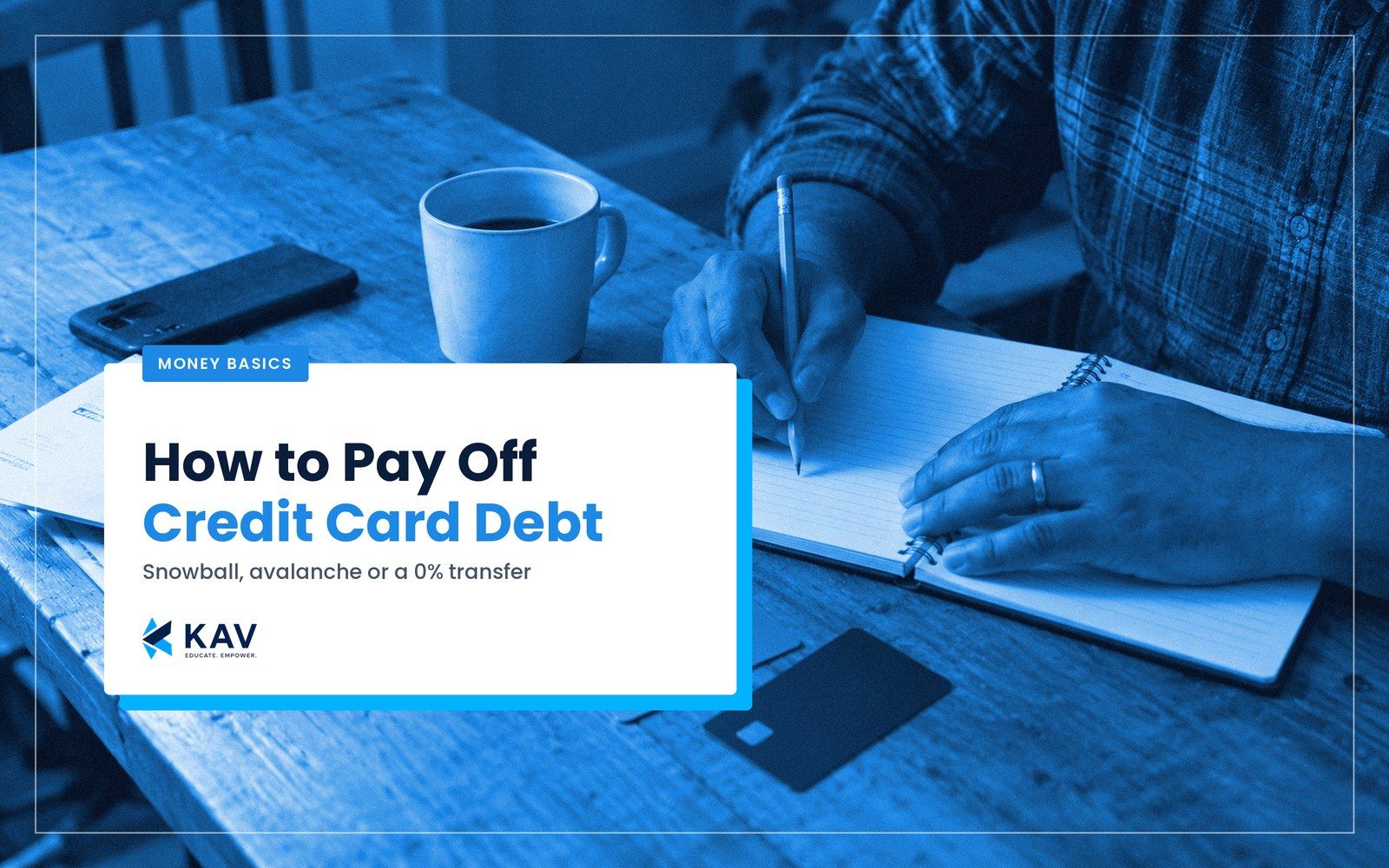
Here's how to pay off credit card debt in an order that makes sense, what each shortcut really costs, and how to keep the balance from coming back.
The short answer: List every card with its balance, annual percentage rate (APR) and minimum payment. Pay every minimum, then send every extra dollar to one card: the highest APR first (the avalanche) saves the most interest, the smallest balance first (the snowball) clears a card sooner. How much extra you pay matters more than the method. Cards charged interest averaged 22.36% APR in August 2026, per the Federal Reserve.
Key takeaways
- At a 22.36% average APR, much of each minimum goes to interest. Your statement's Minimum Payment Warning box shows how long minimums alone would take.
- Put every minimum on autopay, pick a fixed extra amount, and ask each card company for a lower rate before you choose a method.
- The avalanche (highest rate first) always costs the least; the snowball (smallest balance first) gets the first card to zero sooner.
- In our example, raising the payment from $350 to $600 a month saved 40 months and about $7,000 in interest. The method changed it by $156.
- A 0% balance transfer usually costs a 3% to 5% fee and only works if you clear it before the promo rate ends.
- Can't make the minimums? Call the card company and a nonprofit credit counselor before any debt settlement company.
What your credit card debt is costing you right now
Credit card interest is charged on your balance every month, and at today's rates it adds up fast. The Federal Reserve's G.19 consumer credit release puts the average APR at 22.36% for card accounts that were charged interest in August 2026, and 21.19% across all accounts.
That rate is yearly. Your card company charges about a twelfth of it on your balance each month, and unpaid interest becomes part of next month's balance. At 22.36%, a $5,000 balance builds about $93 of interest in a single month, by KAV's math.
Read the box on your statement
Federal rules make your card company show you the cost of paying slowly. Under Regulation Z, every monthly statement has to carry this warning: "Minimum Payment Warning: If you make only the minimum payment each period, you will pay more in interest and it will take you longer to pay off your balance."
Under that warning, the box shows:
- How long minimums alone would take to pay off today's balance, in months or years.
- The total you'd pay that way, interest included.
- The monthly payment that clears it in 36 months, and how much that saves. The 36-month line can be left off when minimums would finish the job in three years or less.
Find that box on each card's latest statement. It's the quickest honest answer to "how long will this take?"
Two rules that can help you or hurt you
- Extra payments go to the highest rate first. When you pay more than the minimum, the card company must apply the extra "first to the balance with the highest annual percentage rate," under Regulation Z section 1026.53. That matters when one card holds a cash advance at a higher rate, or a 0% promo balance next to new purchases.
- Paying more than 60 days late can raise your rate on everything. The Consumer Financial Protection Bureau (CFPB) warns that "If you're more than 60 days late on a payment, the credit card company can increase your interest rate on all balances" (CFPB).
How to pay off credit card debt, step by step
The plan that works is simple to write down: protect every minimum, find a fixed extra amount, and aim it at one card at a time. Here's the order.
- List every card. Write down the balance, the APR, the minimum payment and the due date for each one. Use the latest statements, not memory. Store cards count too.
- Put every minimum on autopay. "Most credit scores consider repayment history as the number one factor for building a strong credit score," the CFPB says. A missed payment can bring a late fee, and once you're more than 60 days late, a higher rate.
- Find your extra amount. Pick a fixed number you can send every month, even if it's small. Our guide on how to make a budget for beginners walks through finding it line by line. On a tight income, start with what's realistic and add to it with each raise, tax refund or paid-off card.
- Call each card company. Ask for a lower APR. If money is tight, ask about hardship programs. Card companies "offer loss mitigation programs, sometimes called forbearance or hardship programs," some with "a lower monthly payment at a reduced interest rate," the CFPB notes. Get any new terms in writing.
- Pick your method, avalanche or snowball (next section), and write the card order on your list.
- Roll each payment forward. When a card hits zero, add its whole payment, minimum included, to the next card on the list. That rollover is what speeds the plan up.
- Stop adding to the balance. Take the cards out of your phone wallet and your saved shopping accounts while you pay them down. As the CFPB puts it, "Many people don't succeed in paying off their debt by taking on more debt unless they lower their spending."
Debt snowball vs avalanche: which one wins?
The avalanche saves the most money, and the snowball keeps more people going. Both start the same way: pay every minimum, then put all the extra on one target card. They differ only in which card is the target.
- Debt avalanche. Target the card with the highest APR, then the next highest. You pay the least total interest, every time, because the most expensive debt shrinks first.
- Debt snowball. Target the smallest balance, then the next smallest, whatever the rates. The first card hits zero sooner, so you see progress in months instead of a year.
The snowball isn't just a feel-good trick. Researchers at Northwestern University's Kellogg School of Management studied how 6,000 people paid off their card debt through a debt settlement company. They found that "consumers who tackle small balances first are likelier to eliminate their overall debt." The 2012 study by David Gal and Blakeley McShane appeared in the Journal of Marketing Research.
Choose the avalanche if
- You'll stick with a plan even if the first card takes a year to clear.
- One card's rate is far above the others.
- Your balances are large, so the interest gap between the two methods grows.
Choose the snowball if
- You've started and stopped before, and quick wins would keep you going.
- You have a small balance you could clear in two or three months.
- Fewer bills to track would take some stress off.
Worked example: three cards, $13,000 and two methods
Take Denise, 42, a medical billing specialist in Columbus, Ohio, with two teenagers. She's an example, not a client. She owes $13,000 on three cards, and her minimums add up to $350 a month:
- Card A: $1,100 at 18.99% APR, $35 minimum
- Card B: $3,400 at 27.99% APR, $100 minimum
- Card C: $8,500 at 22.99% APR, $215 minimum
In the first month, about $260 of her $350 goes to interest. Here's what each plan costs her, by KAV's math, with the minimums held steady for simplicity:
- Keep paying $350 a month: 69 months, almost six years, and $11,059 in interest.
- Snowball at $600 a month: Card A is gone in month 5, B in month 14 and C in month 29. Total interest: $4,150.
- Avalanche at $600 a month: Card B is gone in month 12, C in month 28 and A in month 29. Total interest: $3,994.
- Either method at $700 a month: done in 24 months, with $3,235 to $3,360 in interest.
The extra $250 a month did almost all the work. It cut 40 months and about $7,000 of interest. Choosing the avalanche over the snowball saved $156 more. So if the snowball is the plan Denise will actually keep, it's a good plan.
When a balance transfer or consolidation loan makes sense
A balance transfer or a consolidation loan can lower the rate you pay, but neither one pays the debt. They help when you already have the extra payment from the steps above and a plan to clear the balance on time.
0% balance transfer cards
A balance transfer moves debt from one card to another, often at a 0% promotional rate. Know three things before you apply:
- There's usually a fee. "Some credit card companies charge a one-time fee of 3 to 5 percent of the balance you're transferring," according to a CFPB guide to choosing a card. A card company "is permitted to charge you a balance transfer fee on a zero percent rate offer" (CFPB).
- The promo rate ends. Under federal law an introductory rate has to last at least six months, and the card company must tell you up front what rate comes after it.
- New purchases can cost you. On a card carrying a promo balance, "any additional purchases you make with the card may get dinged with regular interest charges right away," the CFPB warns. Use the new card for the transfer only.
Keep paying the old card while you wait. The CFPB's guide says to "Continue to make at least the minimum payment while you're waiting for the balance to transfer to the new card."
Example: moving one card to 0%
Say Denise moves Card B's $3,400 to a card with a 15-month 0% offer and a 3% fee. By KAV's math:
- Fee: $102, so she owes $3,502.
- Payment that clears it in 15 months: $233.47 a month.
- The same $233.47 a month at 27.99%: 19 months and $802 in interest.
She comes out about $700 ahead, but only if she clears the balance before the promo ends and doesn't charge anything new to that card.
Consolidation loans and home equity
A debt consolidation loan rolls several cards into one fixed payment. The CFPB cautions that many of the low rates "may be 'teaser rates' that only last for a certain time," and that a lower payment "may be because you're paying over a longer time" (CFPB). Compare the total cost, not just the monthly payment.
A home equity loan turns card debt into debt secured by your house. "If you don't pay back the loan, you could lose your home in foreclosure," the CFPB says. That's a big trade for a lower rate.
If you can't make the minimums: hardship plans, counseling and settlement
If the minimums are already more than you can pay, the order of your calls matters. Start with the people who have the most reason to work with you, and save the riskiest option for last.
- Your card company. The CFPB's advice is direct: "Contact your credit card company immediately." It adds that "Many card companies are willing to work with you to change your payment if you're facing a financial emergency" (CFPB). Explain what happened, what you can pay and for how long. A job loss or a medical bill is exactly the kind of thing to mention.
- A nonprofit credit counselor. Credit counseling organizations "are usually non-profit organizations," and "their counselors are certified and trained in the areas of consumer credit," per the CFPB. A counselor can build a budget with you and may set up a debt management plan: you make one monthly payment to the agency, and it pays your cards. Counselors "may charge fees for some of their services," so get the fees in writing, and confirm your card companies have accepted the plan before you pay.
- Debt settlement, with care. Settlement companies try to get part of your debt forgiven, for a fee. They usually tell you to stop paying your cards while they negotiate. The CFPB warns that "Your credit is further damaged" and you can face more collection efforts and lawsuits (CFPB). Forgiven debt can also be taxed: the Internal Revenue Service (IRS) says "the amount of the canceled debt is taxable" in general, and the creditor may send you a Form 1099-C (IRS Topic 431).
One protection is worth knowing: "A debt settlement company is not allowed to collect fees before settling or resolving your debt," the CFPB says. Walk away from anyone who asks for money up front, promises to make your debt disappear, or tells you to stop talking to your card company.
If you're weighing bankruptcy, that's a legal decision. Talk to a bankruptcy attorney or a legal aid office in your state before you stop paying anything.
Common mistakes that keep people in credit card debt
These come up again and again in the questions people ask online, and each one feels reasonable in the moment.
- Cashing out a 401(k) to pay the cards. Money taken from a 401(k) or an individual retirement account (IRA) before age 59½ usually owes income tax plus "an additional 10% early withdrawal tax unless an exception applies" (IRS). On a $10,000 withdrawal, the extra tax alone is $1,000. A 401(k) loan avoids that only while you repay it: the IRS says repayment "must occur within 5 years," and a loan in default "is generally treated as a taxable distribution" (IRS). Our guide to what a 401(k) is explains how withdrawals work.
- Closing every card the day it's paid off. "If you close some credit card accounts and put most or all of your credit card balances onto one card, it may hurt your credit score," the CFPB says.
- Paying down the cards with no cash cushion. This is the refill problem: you clear the balance, the car needs a repair, and it goes right back on the card. In the Fed's household survey, 63% of adults said they'd cover a $400 emergency expense with cash or its equivalent, while 15% would put it on a card and pay it off over time. Keep a small starter buffer while you pay the cards down; our guide to how much should be in an emergency fund helps you size it.
- Budgeting for an average month only. Car registration, school fees, holidays and summer camp come around every year. Set aside a little each month for them, or they'll land on the card.
Your plan for this week
- Pull the latest statement for every card and copy the balance, APR, minimum and due date onto one page.
- Find the Minimum Payment Warning box on each statement and write down the time it shows.
- Set every minimum to autopay from your checking account.
- Pick your extra monthly amount and your method, and write the card order on the page.
- Call the card with the highest APR and ask for a lower rate, or about a hardship program if you need one.
- Move a small, fixed amount into savings each payday as your buffer.
- Put a date on your calendar three months out to check your progress and raise the extra payment if you can.
If you would like help turning this into a plan, KAV Solutions offers a complimentary Financial Needs Analysis. A licensed insurance professional walks through your goals, your emergency savings and your family's protection needs with you, so a payoff plan and your coverage fit the same budget. The analysis is free and you never pay KAV a fee. If you choose to buy a policy, the insurer pays the professional a commission. For tax questions about settled or forgiven debt, bring the numbers to a tax professional.
Frequently asked questions
Is $20,000 in credit card debt a lot?
It's a lot of interest. At the Federal Reserve's August 2026 average of 22.36% APR for accounts charged interest, a $20,000 balance builds about $373 of interest a month, by KAV's math. Check whether your minimums even cover that, then find the 36-month payment in your statement's Minimum Payment Warning box and use it as your target.
Does paying off credit card debt raise your credit score?
It usually helps. The CFPB says repayment history is the top factor in most credit scores, and that "Experts advise keeping your use of credit at no more than 30 percent of your total credit limit." Paying balances down lowers the share of your limits you're using, and paying on time while you do it protects the factor that counts most.
Should I close a credit card after I pay it off?
Not automatically. The CFPB warns that closing accounts and moving most of your balances onto one card "may hurt your credit score," because it raises the share of your available credit you're using. If a card has an annual fee or tempts you to spend, closing it can still make sense. Otherwise, you can keep it open and unused.
What happens to credit card debt when you die?
It's generally paid from your estate, not by your family. "When someone dies, their debts are generally paid out of the money or property left in the estate," the CFPB says. The exceptions include a joint account holder, a co-signer and, in some community property states, a surviving spouse. Debt paid from the estate leaves less for your family, so count it when you figure out how much life insurance you need.
What if I'm sued over an old credit card debt?
Don't ignore it. The CFPB says to "respond to the lawsuit, either personally or through a lawyer by the date specified in the court papers." If you don't, the court may enter a default judgment, and depending on your state, that can lead to garnished wages or a frozen bank account (CFPB). Most states set time limits of three to six years for suing over debt, and a partial payment may restart the clock (CFPB).
KAV Solutions is a women-led team of licensed insurance professionals based in Pennsylvania. This article is general education, not individualized financial, tax, or legal advice. Card terms, hardship programs and debt collection laws vary by card company and state.