The offer letter says "401(k) with a 50% match on the first 6%," and the benefits portal wants your answer by Friday. Or you started a new job and found 3% of your first paycheck already going to something called a 401(k).
Either way, you're not behind. A 401(k) has only a few moving parts, and once you see how they fit, that enrollment screen gets a lot less mysterious.
The short answer: A 401(k) is a retirement account you get through your job. You choose a percentage of each paycheck to save, either before tax (traditional) or after tax (Roth), and many employers add a match. For 2026, the Internal Revenue Service (IRS) lets you contribute up to $24,500. Withdrawals before age 59½ usually owe an extra 10% tax.
Key takeaways
- A 401(k) is a workplace account funded from your paycheck, taxed when money comes out (traditional) or when it goes in (Roth).
- You pick the percentage, the tax treatment and the investments; for 2026 you can put in up to $24,500, more at 50 and older.
- The most common match in Vanguard plans is 50 cents per dollar on the first 6% of pay, so saving less leaves match money unclaimed.
- Your own contributions are always yours, but the match may vest over years; on a 6-year graded schedule you own 40% after three.
- Changing jobs doesn't cost you your own savings, and a direct rollover avoids the 20% withholding on a check made out to you.
What is a 401(k)?
A 401(k) is a retirement savings account you join through your employer: part of each paycheck goes into an account in your name and is invested for later. In the IRS's words, it lets an employee "elect to have the employer contribute a portion of the employee's wages to an individual account under the plan" (IRS 401(k) plan overview).
- The name is a tax-code address. It comes from section 401(k) of the Internal Revenue Code, titled "Cash or deferred arrangements" (26 U.S.C. 401).
- You get it through work. If your employer doesn't offer one, an individual retirement account (IRA) is the account you can open yourself.
- It has cousins. Some employers offer a 403(b), a governmental 457 plan or the federal Thrift Savings Plan instead, with the same $24,500 limit for 2026.
How does a 401(k) work, step by step?
A 401(k) works through payroll: you pick a percentage, your employer takes it out of each paycheck before the rest reaches your checking account, and the plan invests it.
- You enroll, or you're enrolled for you. In Vanguard's How America Saves 2026, 61% of plans had automatic enrollment by the end of 2025, and 32% of those started people at 3% of pay.
- You choose a percentage of pay. It'll come out of every paycheck until you change it in the benefits portal.
- You choose traditional, Roth or a mix (below).
- You choose investments, or take the default. Most plans offer target-date funds, single funds built around the year you expect to retire; 96% of Vanguard plans did. The balance rises and falls with the markets.
- Your employer may add money. That's the match, covered next.
Traditional or Roth 401(k)?
- Traditional (pre-tax). These contributions "are not subject to federal income tax withholding at the time of deferral," per the IRS. You'll pay income tax when you withdraw.
- Roth (after-tax). You'll pay the tax now. A qualified withdrawal, generally after a five-year period and at 59½ or older, "is not included in your gross income" (IRS designated Roth FAQs).
Vanguard found 98% of its plans offered Roth at the end of 2025, but only 18% of participants used it. The choice turns mostly on your tax rate now versus in retirement, the same trade-off as Roth vs. traditional IRAs.
How much can you put in for 2026?
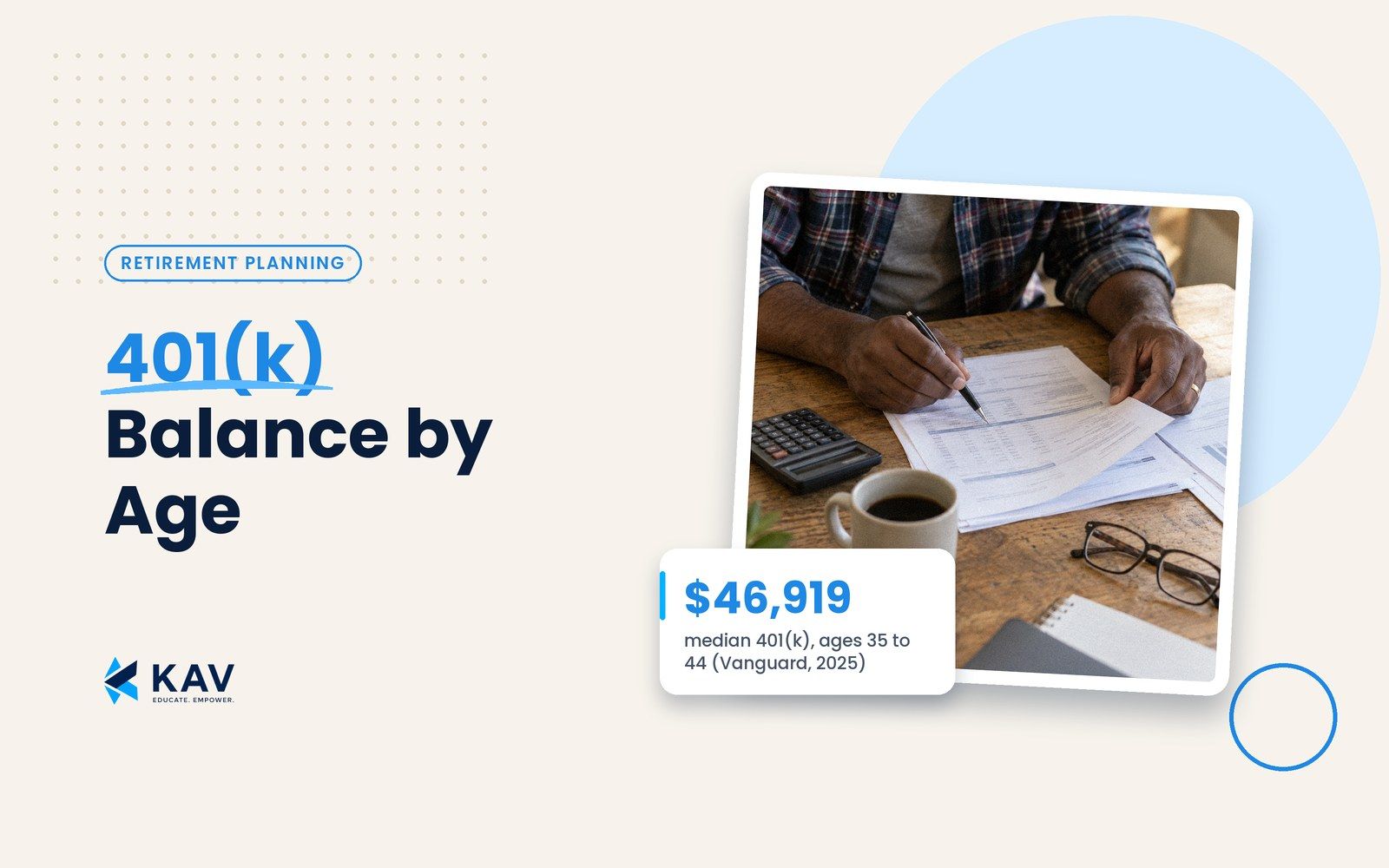
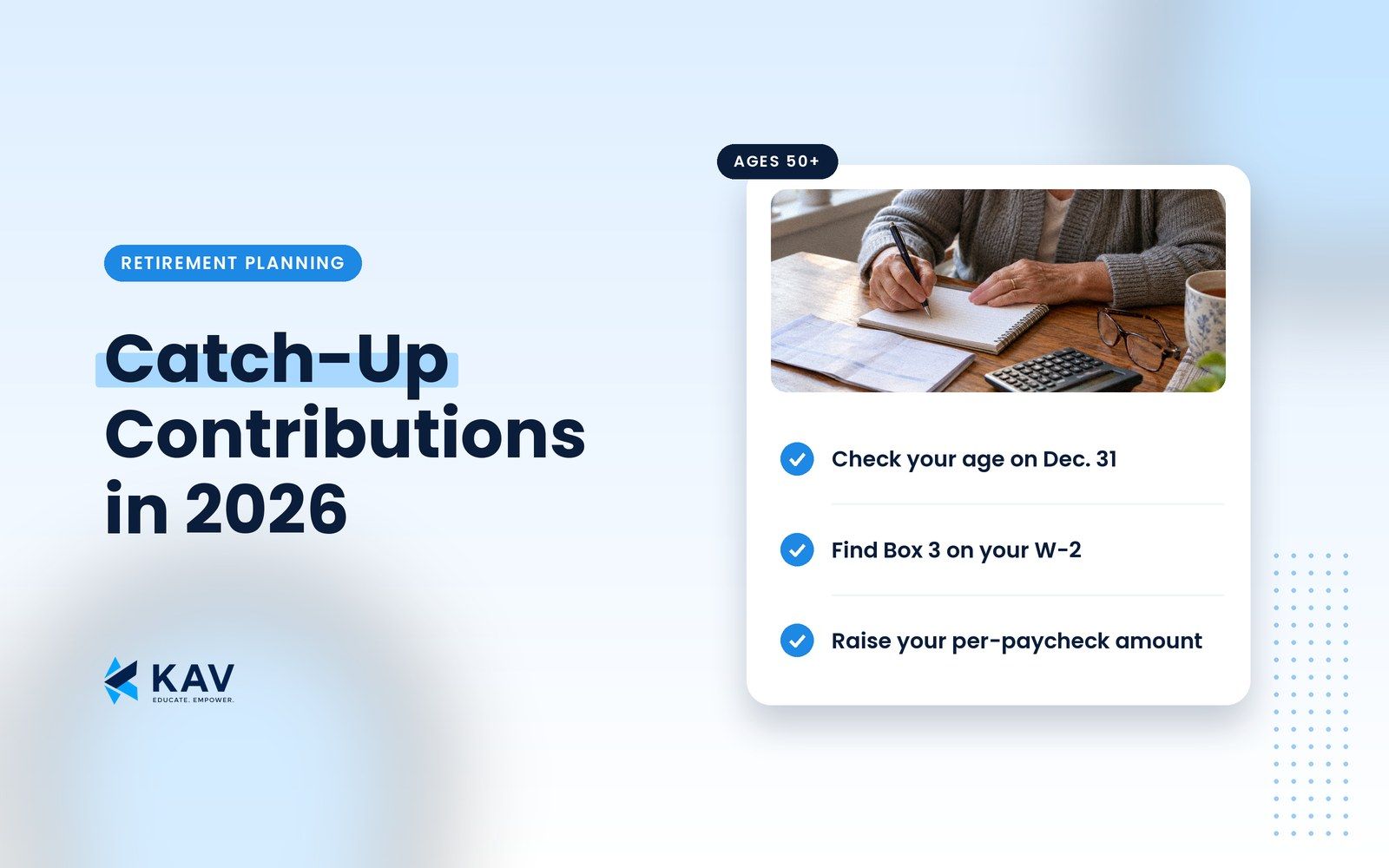
Per the IRS 2026 limits announcement, you can put in up to $24,500 of your own pay, plus an $8,000 catch-up at 50 and older, or $11,250 at ages 60 to 63. You don't need to start anywhere near that. For a sense of where other savers stand, see the average 401(k) balance by age; if you're 50 or older, see 401(k) catch-up contributions in 2026.
How does a 401(k) match work? An example
A 401(k) match is money your employer adds based on what you contribute, so you only get it if you put money in yourself. Vanguard administered more than 100 different match formulas in 2025. The most common was 50 cents per dollar on the first 6% of pay, and the average promised match was 4.7% of pay (median 4.0%).
Take Keisha, 29, a dental office manager in Arizona who earns $52,000 and is paid every two weeks. She's an example, not a client. Her plan uses that common formula:
- She saves 6% of pay: $3,120 a year, or $120 a paycheck.
- Her employer adds half of that: $1,560 a year, or $60 a paycheck.
- Total going in: $4,680 a year.
- If she saved 3% instead: $1,560 from her and $780 from her employer, leaving $780 a year unclaimed.
The arithmetic is ours, but the point holds for any formula: the match pays only on what you actually save. So the first number worth knowing is the rate that earns the whole match. In Vanguard plans, the median rate needed was 6.0% of pay.
When is the 401(k) match really yours? Vesting
Vesting decides how much of your employer's money you keep if you leave. "'Vesting' in a retirement plan means ownership," the IRS says, and your own contributions are "always 100% vested, or owned, by the employee" (IRS on vesting). The match vests one of three ways:
- Immediate. It's yours the day it lands. Nearly half of Vanguard plans did this in 2025, and safe harbor 401(k) plans must make employer contributions "fully vested when made."
- Cliff. 0% until a set point, then 100%. In the IRS example, you're fully vested after three years of service.
- Graded. A bigger slice each year: 20% after two years, 40% after three, up to 100% after six in the IRS example. Vanguard found 22% of plans with a match used a 5- or 6-year graded schedule.
Back to Keisha: three years of full match adds up to $4,680 before investment growth. On the 6-year graded schedule, leaving after three years, she'd own 40% ($1,872) and could lose $2,808. Under the 3-year cliff, she'd own all of it.
Questions to ask HR before you enroll
Your plan's rules sit in its summary plan description (SPD), which the U.S. Department of Labor says "tells participants what the plan provides and how it operates." The plan must give it to you free. Ask human resources (HR) for it and look for:
- When the match starts. Vanguard found eligibility rules are more restrictive for employer contributions, including the match, than for your own.
- How the match is paid. Every paycheck or once a year, and whether you must be employed on a certain date to get it.
- The vesting schedule, and the date you'd be fully vested.
- The defaults: the contribution rate, any automatic yearly increase and the fund you'd land in.
Taking money out, and what happens when you leave a job
A 401(k) is built for retirement, so early withdrawals are expensive: before age 59½ you'll generally owe income tax plus "an additional 10% early withdrawal tax unless an exception applies," according to the IRS.
One exception surprises people. If you leave a job "during or after the year the employee reaches age 55," withdrawals from that employer's 401(k) skip the 10% additional tax. It doesn't apply to IRAs, so rolling that money into an IRA first gives it up.
Your choices when you change jobs
Your own money and any vested match go with you. The IRS lists three options:
- Leave it in the old plan, especially if you like its investments and fees.
- Roll it into your new employer's plan, if that plan accepts rollovers.
- Roll it into an IRA. Moving pre-tax money into a Roth IRA means paying income tax on it that year.
Ask for a direct rollover, where the old plan sends the money straight to the new account. A check made out to you is "subject to mandatory withholding of 20%, even if you intend to roll it over later" (IRS rollover rules). You'd then have 60 days to deposit the full amount, covering the withheld part with other money.
Cashing out costs more than the check suggests. Our arithmetic on a $10,000 balance (the IRS's own example size), for someone under 55 who leaves a job:
- Withheld: $2,000 (20%), so $8,000 arrives.
- Taxed as income: the full $10,000.
- Additional tax: $1,000 (10%), unless an exception applies.
For cash between jobs, an emergency fund is usually a cheaper source.
Where to start this week
- Log in to your benefits portal. Find your contribution rate and whether you were enrolled automatically.
- Find your match formula and, if your budget allows, set your rate high enough to get all of it.
- Ask HR for the summary plan description and read the match and vesting sections.
- Check your investments. If you never picked any, find out what the default fund is. KAV doesn't give investment advice; your plan's resources or a securities-registered professional can help.
- Name a beneficiary on the account, and check it after a marriage, divorce or new baby.
To see what a steady savings rate could add up to by retirement, try the retirement calculator.
If you would like help turning this into a plan, KAV Solutions offers a complimentary Financial Needs Analysis. A licensed insurance professional walks through your retirement goals, your emergency savings and your family's protection needs with you. The analysis is free and you never pay KAV a fee. If you choose to buy a policy, the insurer pays the professional a commission. For the pre-tax or Roth decision, bring your numbers to a tax professional.
Frequently asked questions
Is a 401(k) worth it without a match?
It can be. Without a match, the draw is the tax treatment and the higher limit: $24,500 for 2026, compared with $7,500 for an IRA. With no match to offset them, the plan's fund choices and fees matter more, so look at both before deciding how much goes in.
Can a 401(k) lose money?
Yes. A 401(k) is invested, usually in funds that hold stocks and bonds, so its value rises and falls with the markets. A bad year can shrink the balance, even though the account stays in your name. In Vanguard plans, 84% of participants used target-date funds when they were offered.
Can I have a 401(k) and an IRA?
Yes. The limits are separate, so one doesn't shrink the other: for 2026, up to $24,500 in a 401(k) and up to $7,500 in an IRA. With a workplace plan, your traditional IRA deduction "may be reduced, or phased out," the IRS says, depending on filing status and income. Roth IRA eligibility phases out between $153,000 and $168,000 of income for single filers and heads of household in 2026.
Can you borrow from your 401(k)?
Only if your plan allows it; the IRS says a plan "may, but is not required to provide for loans." The limit is generally the lesser of $50,000 or half your vested balance (up to $10,000 if half is less). Loans are generally repaid within five years. An unpaid loan is treated as a taxable distribution (IRS loan FAQs).
KAV Solutions is a women-led team of licensed insurance professionals based in Pennsylvania. This article is general education, not individualized financial, tax, or legal advice. Plan rules vary by employer, and the figures here are the 2026 limits.