Everyone tells you to "let compound interest do the work." Fewer people explain where that work actually happens. Is it your savings account? Your 401(k)? And why does the same idea make a credit card balance seem to grow on its own?
So how does compound interest work, in real numbers, and which of your accounts is it working in right now? Here's the math, then the map.
The short answer: Compound interest is interest earned on your original money and on the interest it has already earned. In the Consumer Financial Protection Bureau's example, $1,000 at 5% a year becomes $1,050 after one year and $1,102.50 after two, because year two's interest is figured on $1,050. The same math runs in reverse on a credit card balance, where many issuers compound it daily.
Key takeaways
- Simple interest pays only on the original amount. Compound interest also pays on past interest, so $1,000 at 5% earns $102.50 in two years, not $100.
- Rate, compounding frequency (shown in the annual percentage yield, or APY) and time drive growth. Divide 72 by the rate to estimate years to double.
- Savings accounts, U.S. savings bonds and a certificate of deposit (CD) all pay compound interest. A 401(k) grows by reinvested returns, which aren't guaranteed.
- Credit cards compound against you, often daily. The average rate on accounts charged interest was 22.36% in August 2026, per the Federal Reserve.
How does compound interest work?
Compound interest is interest you earn on your original deposit plus the interest that deposit has already earned. The Securities and Exchange Commission (SEC) says it in one line on Investor.gov: "Compound interest is the interest you earn on interest."
The difference from simple interest comes down to where each year's interest goes:
- Simple interest is paid only on the original amount. $1,000 at 5% earns $50 every year, so two years adds $100.
- Compound interest is added to the balance, and next year's interest is figured on the bigger number.
Here's the Consumer Financial Protection Bureau (CFPB) example from its compound interest explainer, with $1,000 at 5% compounded once a year:
- Year one: 5% of $1,000 is $50, so the balance is $1,050.
- Year two: 5% of $1,050 is $52.50, so the balance is $1,102.50.
That extra $2.50 looks like nothing. It's the start of a curve. In the SEC's own example, $100 left alone at 5% grows to more than $162 in 10 years and almost $340 in 25, without another dime added.
What makes compound interest grow faster?
Three things decide how fast compound interest grows: the rate, how often interest is added, and how long the money stays put. The CFPB names one more lever you control directly: adding to your principal.
How often it compounds, and what APY tells you
Interest can be added once a year, once a month or every day. Banks fold the rate and the schedule into one number, the APY. Under the federal Truth in Savings rules, APY reflects "the interest rate and the frequency of compounding for a 365-day period," while the plain interest rate "does not reflect compounding."
As an example, a 4% rate compounded daily works out to a 4.08% APY. When you're comparing savings accounts, compare APYs, not rates.
The rule of 72
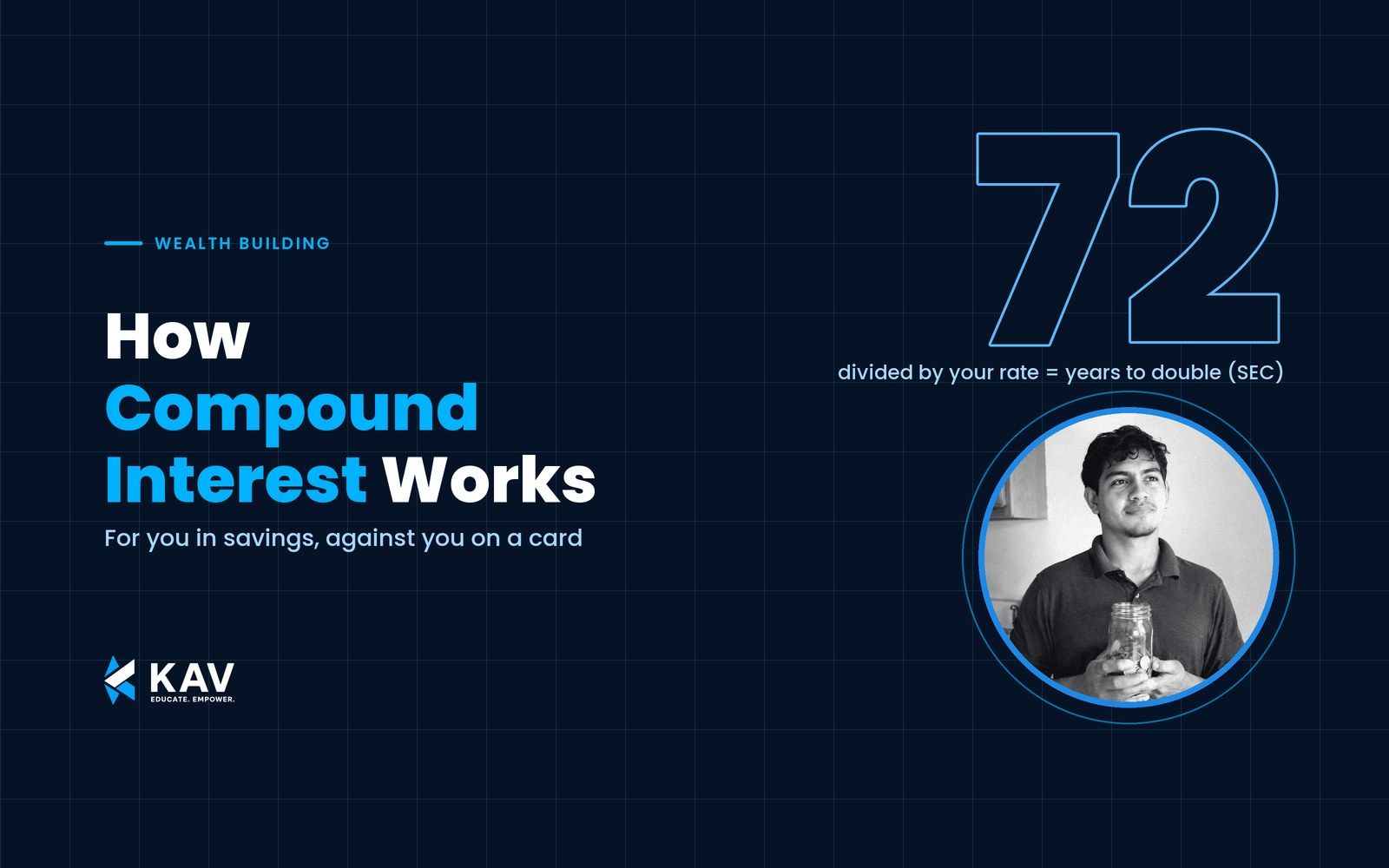
The rule of 72 estimates how many years it takes money to double: divide 72 by the annual rate. Investor.gov's example is 9%, which doubles money about every 8 years. The Federal Reserve Bank of St. Louis adds that 2% takes about 36 years and 12% about six, and calls the rule "an approximation."
Time does the heavy lifting
Time matters more than it looks, because the biggest years of growth come last. The St. Louis Fed's illustration assumes 8% a year, compounded annually:
- Starts at 25: invests $5,000 a year for 10 years ($50,000 in all), then stops. About $787,180 at 65.
- Starts at 35: invests $5,000 a year for 30 years ($150,000 in all). About $611,730 at 65.
The early saver put in a third as much and still finished ahead, because those deposits had 10 extra years to compound. The 8% is the Fed's assumption for the math, not a rate any account promises.
Where compound interest works for you
You earn true compound interest on bank deposits and U.S. savings bonds. Retirement accounts compound differently, through investment returns that can rise or fall.
- Savings and money market deposit accounts. They pay interest, usually quoted as an APY. The Federal Deposit Insurance Corporation (FDIC) insures deposits up to $250,000 per depositor, per insured bank, for each ownership category. Rates vary a lot: the FDIC's national average for savings was 0.38% as of Oct. 19, 2026. Our comparison of high-yield savings vs money market accounts shows what to check in the fine print.
- Certificates of deposit (CDs). Also insured deposits, with your money committed for a set term. The national average for a 12-month CD was 1.76% on the same date.
- U.S. savings bonds. For I bonds, the Treasury says on TreasuryDirect that it adds the interest earned "twice a year" to the bond's value, then applies the next rate "to that entire new value."
- 401(k)s and IRAs (individual retirement accounts). They're accounts, not interest rates. The money inside usually goes into stocks, bonds or mutual funds, which the FDIC lists as not insured. Reinvested gains and dividends compound too, but they can also fall. Our guide to what a 401(k) is explains how an employer match adds to it. Choosing the investments is a question for your plan's materials or a securities-registered professional.
Where compound interest works against you
Credit card balances are where compound interest runs in reverse, because many issuers add interest to the balance every day. The CFPB's daily periodic rate explainer puts it plainly: "This interest amount is then added to the previous day's balance, which means that interest is compounding on a daily basis." The daily rate is the annual percentage rate (APR) divided by 360 or 365, depending on the card.
And the rates aren't small. The Federal Reserve's G.19 consumer credit release put the average rate on card accounts that were charged interest at 22.36% in August 2026, a preliminary figure.
The way to keep compounding off your card entirely is the grace period. On most cards, if you pay the full balance by the due date, you can avoid interest on new purchases, according to the CFPB's grace period explainer. Pay in full some months and not others, and you can lose it for that month and the next.
Mortgages and car loans work differently
A standard mortgage or car loan doesn't snowball like a card. Each monthly payment covers that month's interest plus some principal, so, as the CFPB's mortgage explainer says, "you owe less interest each month, because your loan balance is lower." The exception is negative amortization: when payments don't cover the interest, "the unpaid interest gets added to the amount you borrowed."
An example: one 25-year-old, both directions
Here's what both sides look like in one household. Take Marco, 25, a warehouse supervisor in San Antonio. He's an example, not a client. He has $1,000 in savings and $3,000 on a card charging 22.36%.
- His savings: at the 0.38% national average, about $3.80 of interest in a year. At a hypothetical 4% APY, $40.
- His card: 22.36% divided by 365 is about 0.061% a day, or $1.84 of interest on day one. With no payment and no new purchases for 30 days, that's $55.63.
- The doubling math: at 4%, his savings double in about 18 years. At 22.36%, an untouched card balance would double in a little over three.
That's why the rate on debt usually matters more than the rate on savings when you're deciding where an extra $100 goes. Our guide on how to pay off credit card debt compares the payoff methods.
Where to start this week
- Find the APY on your savings statement. Compare it with the FDIC's 0.38% national average and with inflation, which ran 3.7% for the 12 months through September 2026, according to the Bureau of Labor Statistics.
- Look up your card's APR and check whether you paid the full balance last month. If you didn't, interest is compounding now.
- Set up an automatic transfer the day after payday, even a small one. It's the "adding to your principal" lever, and it builds your emergency fund at the same time.
- Run your own numbers in KAV's retirement calculator to see how time and regular deposits add up for you.
If you would like help turning this into a plan, KAV Solutions offers a complimentary Financial Needs Analysis. A licensed insurance professional walks through your goals, what you owe and the protection your family relies on with you. The analysis is free and you never pay KAV a fee. If you choose to buy a policy, the insurer pays the professional a commission.
Frequently asked questions
At what point does compound interest take off?
There's no single switch, but each year's growth gets bigger as the balance grows. In the SEC's example, $100 at 5% earns $5 in year one and reaches almost $340 by year 25. By the rule of 72, money at 5% doubles about every 14 years, so the later doublings add the most dollars.
Can compound interest beat inflation?
Only when the rate is higher than inflation. Prices rose 3.7% in the 12 months through September 2026, according to the Bureau of Labor Statistics, while the FDIC's national average savings rate was 0.38% in October 2026. At that gap, the balance grows but it buys less. A higher-yield account narrows the gap.
Is APY the same as APR?
No. APY, the annual percentage yield, is what a deposit account pays in a year with compounding included. APR, the annual percentage rate, is the yearly rate a card or loan charges, and on many cards it's applied as a daily rate that compounds. By KAV's math, a 22.36% APR compounded daily for a year with no payments works out to about 25%.
How much will $1,000 grow in 10 years?
It depends on the rate and the schedule. At a fixed 4% compounded once a year, $1,000 grows to about $1,480 in 10 years, compared with $1,400 under simple interest. At the 0.38% national average savings rate, it reaches about $1,039. Higher rates and longer timelines widen the gap.
KAV Solutions is a women-led team of licensed insurance professionals based in Pennsylvania. This article is general education, not individualized financial, tax, or legal advice. Rates shown are published averages or examples, not offers, and investment returns aren't guaranteed.